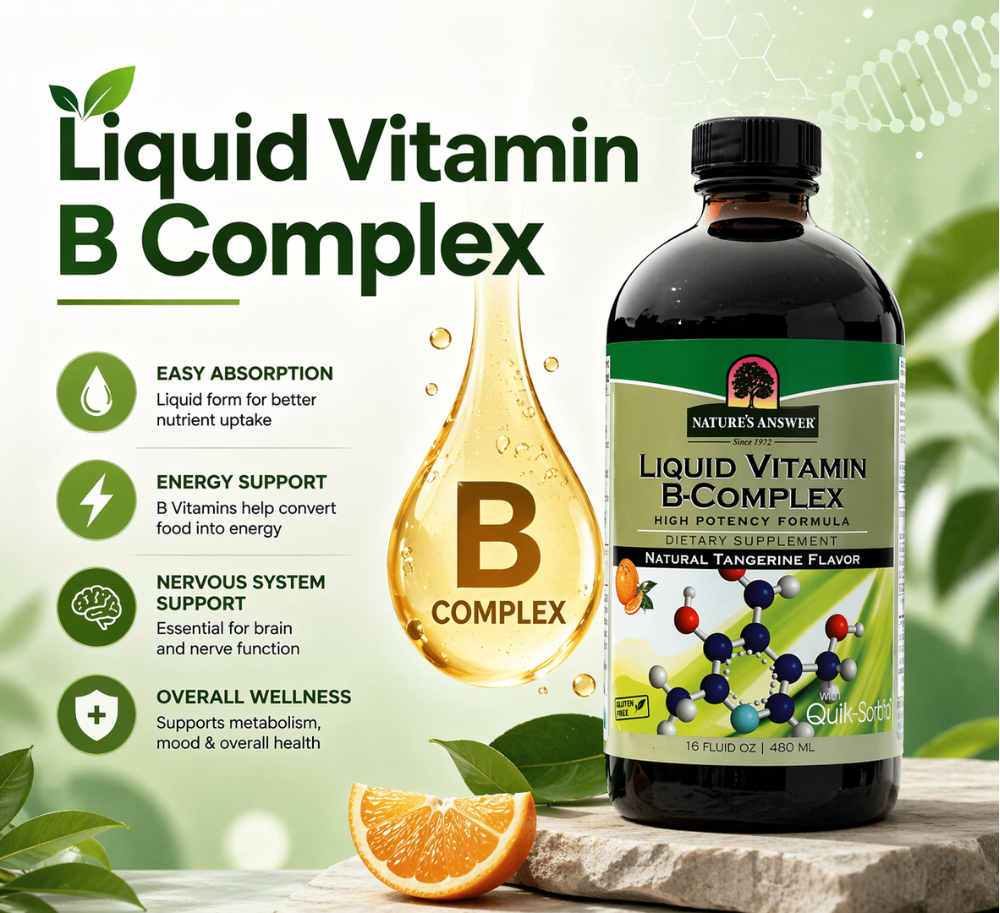
"Absorbs up to 98% more than tablets." "Higher bioavailability." "Bypasses the digestive system." If you have shopped for a liquid vitamin, you have read something like this. It sounds like settled science. It mostly is not.
This is an honest look at what absorption claims mean, where the format of a supplement genuinely matters, and where the difference is smaller than the price gap suggests. The short version: liquids have real practical advantages, but "liquid absorbs better than pills" is a marketing position, not an established fact, and it is worth knowing which parts of the claim hold up.
What "bioavailability" actually means
Bioavailability describes how much of a nutrient reaches your bloodstream in a usable form, and how quickly. It is a measurable property, but it is measured for a specific nutrient in a specific formulation, in specific people. It is not a property of a whole product category.
That distinction is the crux of the issue. A claim that "liquids are more bioavailable" treats format as if it were the deciding factor. In reality, absorption depends on the chemical form of the nutrient, the dose, what else is in the product, whether you take it with food, and the state of your own digestive system. Format is one input among several, and often not the most important one.
The dissolution argument, examined
The most common argument goes: a tablet must break down before your body can absorb it, whereas a liquid is already dissolved, so absorption is faster and more complete.
The first half is true. Tablets do have to disintegrate and dissolve, and a poorly made tablet that does not break down properly is a genuine quality problem. Pharmacopoeial standards exist precisely because this can go wrong.
The second half does not automatically follow. For a well-made tablet, disintegration happens in the stomach in a matter of minutes, and for most water-soluble vitamins that step is not the bottleneck. What limits absorption is usually the transport mechanism in the intestine — how much the gut can actively take up in a given period — and that limit applies whether the nutrient arrived as a liquid or a dissolved tablet.
Speed is a fair claim in some cases. "More total absorption" is a much stronger claim and needs evidence specific to the nutrient in question.
Claims that do not hold up
- "Liquids bypass digestion." Anything you swallow goes through your digestive tract. Sublingual products are a partial exception in principle, but a liquid you drink is not sublingual.
- "Smaller particle size means better absorption." A dissolved substance does not have a particle size in any meaningful sense. This borrows language from a different context.
- "Stomach acid destroys vitamins in tablets." Stomach acid is part of normal digestion and affects a nutrient the same way regardless of what it arrived in. Where acid genuinely matters — as with B12 — it is about releasing the nutrient from food protein, which does not apply to any supplement form.
- Specific percentage figures such as "98% absorbed versus 10% for tablets" are almost never traceable to a published comparison of the two products being sold.
Where format genuinely does matter
None of this makes liquids pointless. There are real, defensible reasons to choose one.
- Difficulty swallowing. This is the strongest reason and needs no scientific hedging. For children, many older adults, people with dysphagia after a stroke, and anyone who simply cannot get a large tablet down, a liquid is the format that gets taken. A supplement that stays in the cupboard has zero bioavailability.
- Dose flexibility. Liquids can be measured in small increments, which matters for children and for anyone titrating a dose on clinical advice.
- Feeding tubes. Liquid formulations are often the only practical option.
- Some malabsorption conditions. After certain bowel surgery, or with conditions affecting the gut lining, absorption can be genuinely impaired — but the answer there is usually a specific chemical form or a different route entirely, decided by a clinician, not a general switch to liquids.
- Adherence. If you find a liquid pleasant and a tablet unpleasant, you will take it more consistently. Consistency beats a marginal theoretical absorption difference every time.
Note that none of these are absorption arguments. They are practical ones, and they are perfectly good reasons on their own.
The trade-offs liquids come with
An honest comparison runs both ways.
- Stability. Some vitamins are less stable in solution. Liquids often have shorter shelf lives and may need refrigerating after opening. Check the label rather than assuming.
- Added ingredients. Liquids commonly need sweeteners, flavourings and preservatives to be palatable and stable. Tablets need fewer.
- Dosing accuracy. A tablet is a fixed dose. A liquid depends on you measuring it, and "a capful" varies.
- Cost per dose. Liquids are frequently more expensive for the same nutrient content.
- Dental considerations. Sweetened or acidic liquids taken daily are worth rinsing after.
What matters more than format
If you want to improve how much benefit you get from a supplement, these are higher-leverage than choosing liquid over tablet.
- Do you actually need it? Supplementing a nutrient you are not short of does not generally produce a benefit, at any absorption rate.
- The chemical form. This genuinely varies. Different salts and forms of the same mineral differ in how well they are absorbed and tolerated — and that is a property of the form, not of whether it is liquid.
- Timing with food. Fat-soluble vitamins are better absorbed with a meal containing fat. Some minerals compete with each other and with tea and coffee.
- Third-party testing. Independent verification that the product contains what the label says is worth more than any absorption claim.
- Taking it consistently. Unglamorous, and the biggest factor by far.
A note on safety
Supplements can interact with prescription medicines, and some can affect medical tests. If you take any prescription medication, are pregnant or breastfeeding, or have an ongoing health condition, check with your doctor or pharmacist before starting a supplement — pharmacists are easy to reach and this is exactly the kind of question they are good at.
One specific point worth flagging: high-dose biotin, which is common in B-complex and hair supplements, is known to interfere with certain laboratory tests, including some thyroid and cardiac tests, potentially producing misleading results. Tell your doctor or the lab if you take it.
If you are comparing formats, All Care Store's multivitamins range covers both tablet and liquid options.
Related reading
- What each B vitamin actually does — a plain-English reference to B1 through B12.
- B12 and folate — what seniors, vegetarians and people on metformin or acid reducers need to know. This is the one case where absorption genuinely is the central issue.
- Biotin dosage and safety — including the lab-test problem in more detail.