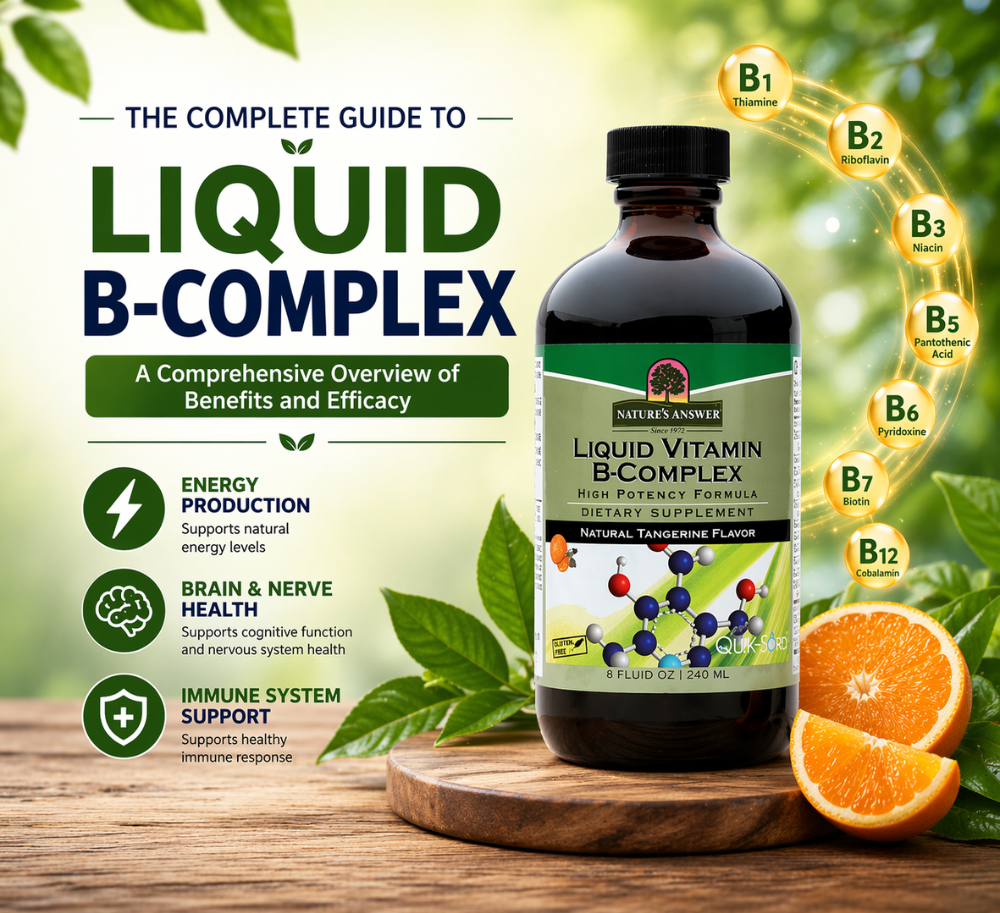
"B-complex" is a convenient label for eight chemically unrelated vitamins that happen to share a few traits: they are water-soluble, they mostly act as enzyme cofactors, and they were named in the order they were isolated. That is genuinely all they have in common. They are not a team, and lumping them together hides the fact that they do quite different jobs, and that only some of them are ones most people need to think about.
This is a reference guide. Each vitamin gets its number, its name, what it actually does, what happens when it is short, and where to find it in food. Use it to look things up rather than reading start to finish. For the delivery-format question, see our comparison of liquid versus pill B-complex.
Vitamin B1 — Thiamine
What it does: Thiamine becomes thiamine pyrophosphate, the cofactor for enzymes that sit at critical junctions of carbohydrate metabolism — converting pyruvate for entry into the citric acid cycle, and one step of the cycle itself. Because the brain runs almost entirely on glucose, it is unusually sensitive to thiamine shortage.
When it is short: Deficiency causes beriberi, which appears in two forms: one affecting nerves with numbness, weakness and burning feet, and one affecting the heart with swelling and shortness of breath. Severe acute deficiency causes Wernicke encephalopathy — confusion, eye movement abnormalities and unsteady gait — a medical emergency most associated with chronic alcohol use.
Where to get it: Pork, whole grains, fortified cereals and breads, legumes, sunflower seeds.
Worth noting: Chronic heavy alcohol use, bariatric surgery and prolonged vomiting all deplete thiamine relatively quickly, since body stores are small.
Vitamin B2 — Riboflavin
What it does: Riboflavin forms FAD and FMN, two workhorse cofactors in the electron transport chain and in fatty acid oxidation. It is also needed to activate vitamin B6 and to convert folate into usable forms, which makes it quietly upstream of two other B vitamins.
When it is short: Cracks at the corners of the mouth, a sore magenta-coloured tongue, sore throat, and a scaly rash. Isolated riboflavin deficiency is uncommon; it usually travels with other B shortfalls.
Where to get it: Dairy, eggs, organ meats, almonds, mushrooms, fortified cereals.
Worth noting: Riboflavin is destroyed by light, which is why milk is not sold in clear glass. It is also the reason supplements turn urine bright yellow — harmless, and simply the excess being excreted.
Vitamin B3 — Niacin
What it does: Niacin becomes NAD and NADP, the cofactors that carry electrons in hundreds of reactions across energy metabolism, plus DNA repair and cell signalling. The body can also make some niacin from the amino acid tryptophan, so protein intake affects requirement.
When it is short: Pellagra, historically summarised as the four Ds — dermatitis on sun-exposed skin, diarrhoea, dementia and, untreated, death. Rare where diets are varied.
Where to get it: Poultry, beef, fish, peanuts, whole grains, fortified cereals.
Worth noting: Niacin is the B vitamin most likely to cause a noticeable effect at high dose — the "niacin flush", a hot red skin reaction. High-dose niacin has also been used therapeutically for lipid management under medical supervision, and at those doses it can affect the liver. This is not a vitamin to megadose casually.
Vitamin B5 — Pantothenic Acid
What it does: Forms coenzyme A, the molecule that carries acyl groups through fatty acid metabolism, the citric acid cycle and steroid hormone synthesis. Its name comes from the Greek for "from everywhere", which is a fair description of its food distribution.
When it is short: Essentially never seen in isolation outside experimental settings, where it produced numbness and burning in the feet.
Where to get it: Almost everything — meat, eggs, dairy, mushrooms, avocado, whole grains, broccoli.
Worth noting: Claims that B5 treats acne relate to high doses well above dietary levels and are not well supported.
Vitamin B6 — Pyridoxine
What it does: Becomes pyridoxal 5'-phosphate, the busiest cofactor of the group — involved in well over a hundred enzyme reactions. It handles amino acid metabolism, the synthesis of serotonin, dopamine and GABA, haemoglobin production, and the breakdown of homocysteine.
When it is short: Skin rash, cracked lips, a swollen tongue, low mood, confusion, weakened immune response and, in severe cases, anaemia.
Where to get it: Chickpeas, poultry, fish, potatoes, bananas, fortified cereals.
Worth noting: B6 is the one B vitamin with a well-documented toxicity from supplements. Sustained intake far above the recommended amount can cause sensory nerve damage, sometimes only partly reversible. If you are taking a high-dose B6 product long-term, check the number against the upper limit and discuss it with your pharmacist.
Vitamin B7 — Biotin
What it does: Acts as the cofactor for five carboxylase enzymes handling fat synthesis, glucose production and amino acid breakdown. The link to hair, skin and nails is real but runs through lipid synthesis in fast-turnover tissue — it is a deficiency story, not an enhancement one.
When it is short: Thinning hair, a scaly rash around the eyes and mouth, brittle nails, fatigue.
Where to get it: Cooked egg, liver, salmon, sunflower seeds, almonds, sweet potato.
Worth noting: High-dose biotin distorts common blood tests, including thyroid panels and cardiac troponin. This is a genuine clinical issue, covered in our guide to biotin dosage, safety and lab-test interference, with the mechanism explained in what biotin actually does in your body.
Vitamin B9 — Folate
What it does: Carries single-carbon units for DNA synthesis and repair, and for cell division. It also converts homocysteine to methionine, a reaction that requires B12 as a partner.
When it is short: Megaloblastic anaemia, in which red blood cells are made too large and too few, causing fatigue and breathlessness. In early pregnancy, low folate raises the risk of neural tube defects — which is why folic acid supplementation before conception and in the first trimester is standard advice and why many countries fortify flour.
Where to get it: Leafy greens, lentils, beans, asparagus, citrus, fortified grains.
Worth noting: Folate and B12 are entangled. High folate intake can correct the anaemia of B12 deficiency while the neurological damage continues unnoticed — which is exactly why B12 should be checked rather than assumed. If you are pregnant or planning to be, see prenatal vitamins and discuss dosing with your provider.
Vitamin B12 — Cobalamin
What it does: Required by exactly two human enzymes — one that regenerates methionine from homocysteine alongside folate, and one that processes the products of odd-chain fatty acid and certain amino acid breakdown. Both matter for red blood cell production and for maintaining the myelin sheath around nerves.
When it is short: Fatigue, megaloblastic anaemia, pins and needles in hands and feet, balance problems, memory difficulties and mood change. Nerve damage from prolonged deficiency can become permanent.
Where to get it: Animal foods only — meat, fish, shellfish, eggs, dairy — plus fortified foods and supplements. Plants do not make it.
Worth noting: B12 is the one most people genuinely need to think about. Absorbing it requires stomach acid and a protein called intrinsic factor, so vegetarians and vegans, adults over about 50, people on metformin, and people on long-term acid-reducing medication are all at elevated risk. We cover that group in detail in our guide to B12 and folate for seniors, vegetarians and people on metformin or acid reducers.
Reading This As A Whole
A few patterns are worth pulling out.
- They are not equally important to worry about. B5 and biotin deficiencies are rare. B12 shortfall is common in identifiable groups. Folate matters enormously in pregnancy. That asymmetry is invisible on a B-complex label listing all eight at similar percentages.
- They depend on each other. B2 activates B6 and folate. B12 and folate share a reaction. Biotin's pathway hands off to a B12-dependent enzyme. A single-vitamin view misses this.
- Two have real dose ceilings. B6 can damage nerves at sustained high intake; niacin can cause flushing and liver effects. The rest have wide safety margins.
- Water-soluble does not mean consequence-free. Excess is largely excreted, but "largely" is not "entirely".
A B-complex product covers all eight at modest levels, which suits someone with a generally thin diet. A targeted single vitamin suits someone with a specific identified shortfall. Neither replaces finding out which situation you are in. You can browse the vitamins and supplements, multivitamins and vitamins and minerals ranges to compare formats and strengths.
Before you start: talk to your doctor or pharmacist before beginning a new supplement, particularly if you are pregnant, breastfeeding, taking prescription medication, or managing a health condition — and especially before taking any B vitamin at high dose. This article is general educational information, not medical advice, and B vitamins are not a treatment for any disease.