"Are smelling salts legal?" is the question buyers ask most often — and it is usually the wrong question. In the United States, ammonia inhalants are legal to buy, own, and carry. What actually varies is permission: whether a particular league, commission, school district, or employer allows them in a particular setting.
This guide walks through the rules that genuinely apply to US buyers: how the FDA treats these products, where sports bodies stand, what schools and athletic departments have to consider, how they fit into OSHA and ANSI first-aid kit requirements, and the practical questions about storage, expiration, disposal, and travel.
One caveat up front, and it matters: rules in this area are set by many different bodies and they change. Where policies differ, this article says so rather than pretending there is one universal answer. Always confirm with your own governing body, employer, or district.
The Short Answer on Legality
Ammonia inhalants are not a controlled substance under the federal Controlled Substances Act. There is no federal restriction on an adult purchasing or possessing them, and they are not age-restricted at the federal level the way tobacco or certain pseudoephedrine products are. They are sold openly in pharmacies, medical supply stores, and sporting goods retailers.
So the legal question is easy. The compliance question — "may I use these here, in this role, on this person?" — is the one worth spending time on.
How the FDA Treats Ammonia Inhalants
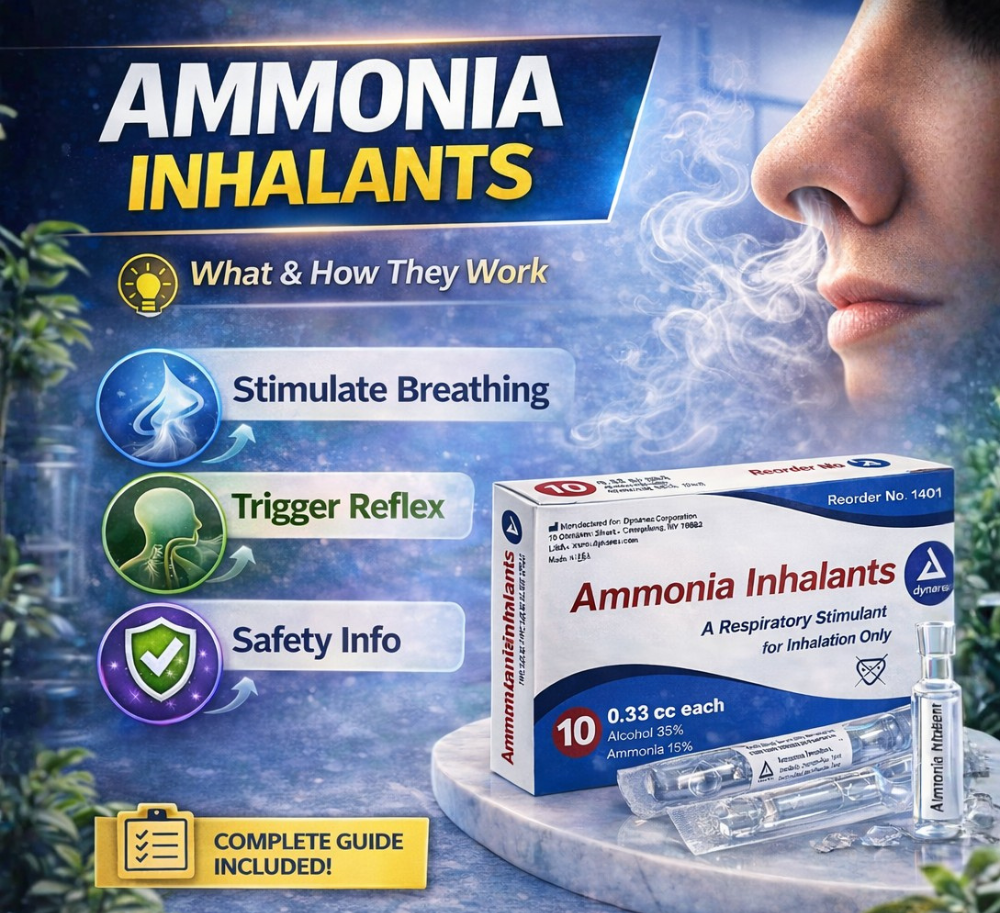
In the US, aromatic ammonia inhalants are regulated as an over-the-counter drug product, marketed as a respiratory stimulant for the temporary relief of faintness or dizziness. Being an OTC drug carries labeling obligations, and those obligations are the buyer's best quality signal.
A properly marketed product should carry:
- A Drug Facts panel with active ingredient, uses, warnings, and directions
- A lot number and an expiration date
- Manufacturer or distributor identification
Novelty "performance" tins sold with no Drug Facts panel, no expiration date, and marketing claims about strength or focus sit in a much murkier position. The FDA has taken issue with products making unapproved performance or therapeutic claims. If you are stocking a clinic, a school, or a workplace kit, buy labeled OTC product — the labeling is what your safety officer or nurse will look for.
One more point the FDA has been explicit about: smelling salts are not a treatment for concussion, and they must never be used to rouse or "clear" an athlete after a head impact. Doing so can mask exactly the symptoms an evaluation depends on. Explore related supplies in our personal care collection.
Medical First-Aid Use vs. Performance Use
Almost every policy debate traces back to this split.
- First-aid use means rousing someone after a simple faint (vasovagal syncope). This is the labeled, intended use, and it is what makes an inhalant a defensible item in a first-aid kit.
- Performance use means an athlete taking a whiff before a heavy lift or a play to feel more alert. This is outside the labeled use. It is not illegal, but it is the use that governing bodies react to.
Keeping the two straight will answer most of your own policy questions. A school nurse stocking a supply cabinet is on very different ground from a 16-year-old carrying a tin in a gym bag.
Sports and Sanctioning Body Positions
There is no single national rule. Positions differ by sport, by federation, and sometimes by state.
Anti-doping
The World Anti-Doping Agency does not list ammonia inhalants on the WADA Prohibited List. Using them is not a doping violation under the World Anti-Doping Code. This is the single most misunderstood point in the category — and it is worth being precise about what it means. "Not prohibited by WADA" is not the same as "permitted by your league." A sport can restrict a substance through its own competition rules without it ever being an anti-doping matter.
Combat sports
Boxing and MMA are where restrictions are tightest. Many state athletic commissions prohibit cornermen from using ammonia inhalants on a fighter between rounds, and the Association of Boxing Commissions has model language along these lines. The reasoning is the concussion logic above: a fighter's response to head trauma must not be chemically masked. Combat sports are regulated state by state, so check the rules of the commission with jurisdiction over your event.
Strength sports
Powerlifting and strongman federations set their own rules and they are not consistent with one another. Some permit use at the platform, some restrict it to a designated warm-up area, and some address it only in meet-day instructions. Read the rulebook for the specific federation you compete under, and check meet-specific notices — individual promoters sometimes add restrictions.
Team sports
US professional leagues generally do not ban ammonia inhalants outright, but individual teams and medical staffs frequently discourage or restrict them, and head-injury protocols are the reason. Team medical policy, not league rulebook, is usually where the actual restriction lives.
High school and youth sports
State high school athletic associations and individual districts set these rules. Many discourage athlete use. Confirm with your state association and your athletic director rather than assuming.
A fair summary: no US governing body treats ammonia inhalants as a banned drug, but several restrict when, where, and by whom they may be used — with head injury as the near-universal red line.
Schools and Athletic Departments
Schools have a distinct set of considerations that surprise a lot of buyers.
- Medication administration rules. Because an inhalant is an OTC drug product, giving one to a student is often treated as administering a medication. That can bring it under the district's medication administration policy and state nurse practice regulations, meaning it should be handled by the school nurse or under a physician or medical director's standing orders — not distributed by a coach.
- Written protocol. Departments that stock them typically place them in the athletic trainer's kit alongside a written protocol covering who may use them and in what circumstances.
- Documentation. Any use connected to a loss of consciousness should be documented, and it should trigger the concussion protocol — never substitute for it.
- Student-carried product. Many districts prohibit students from carrying any drug product on school grounds. A tin in a locker can run afoul of a handbook rule that has nothing to do with ammonia specifically.
Workplace Kits, OSHA and ANSI Z308.1
This is where buyers stocking a business most often want clarity.
- OSHA 29 CFR 1910.151 requires that adequate first-aid supplies be readily available where there is no infirmary or clinic in near proximity. The standard does not itemize contents; its non-mandatory appendix points employers toward the ANSI/ISEA Z308.1 standard as guidance.
- ANSI/ISEA Z308.1 sets minimum contents for Class A and Class B kits — bandages, gauze, antiseptic, burn treatment, eye wash, gloves, a CPR barrier, and so on. Ammonia inhalants are not a required item in either class. They are an optional addition, which means adding them is a business decision, not a compliance obligation.
- Internal approval. Because they are a drug product, many employers route inhalants through the same review as other workplace OTC medications: occupational health sign-off, a written use protocol, and explicit instruction that they are not used where head or spine injury is suspected.
- State plan states and certain industries layer additional first-aid kit requirements on top of federal OSHA. Check your state's occupational safety agency.
And the rule that overrides everything: an inhalant is never a substitute for calling 911. If someone does not regain consciousness promptly, or the faint follows a head impact, chest pain, or seizure, emergency services come first.
Storage, Expiration and Disposal
- Store in a cool, dry place away from direct sunlight and heat sources. Heat drives ammonia out of the ampule and shortens usable life — a glove box in a Texas summer is a bad home for them.
- Ampules carry an expiration date and they do lose potency as ammonia escapes over time. Rotate stock at your scheduled kit inspections rather than assuming a sealed box is fine indefinitely.
- Keep them in the original outer packaging so the Drug Facts warnings stay with the product for whoever opens the kit next.
- Store out of reach of children.
- A used ampule is crushed glass inside an absorbent wrap. Dispose of it in a rigid or sharps container per your facility's policy, not loose in a soft trash bag.
- For expired stock, households can generally discard this type of OTC product in the household trash; workplaces and clinics should follow their own pharmaceutical or hazardous waste procedures.
Air Travel and Shipping
- TSA: over-the-counter medications are permitted in carry-on and checked baggage, and ammonia inhalant ampules travel as a personal OTC medication. They are not on TSA's prohibited items list. Keep them in original labeled packaging — and remember the officer at the checkpoint always has final discretion.
- Airlines: individual ampules are not aerosols, but some carriers maintain their own restricted-item lists. If you are traveling with a large quantity, check the carrier's dangerous goods page.
- International travel: rules differ by country, and some regulate ammonia products more tightly than the US does. Verify with the destination country's customs authority before packing them.
- Shipping: retailers ship these domestically as ordinary consumer goods. Bulk ammonia solution shipments can fall under hazmat rules, but that is a supplier-side issue rather than a consumer one.
A Compliance Checklist Before You Buy
- Does the product carry a Drug Facts panel, lot number, and expiration date?
- Have you checked the rulebook of the specific federation, commission, or state association involved?
- If this is for a school or workplace, does it need medical director sign-off or a written protocol?
- Is there a documented instruction that inhalants are never used after a suspected head injury?
- Is there a scheduled stock rotation so expired ampules are pulled?
- Is there a disposal route for used glass ampules?
Related guides
- Ammonia Inhalants: Myths vs. Facts — Correct Technique and Contraindications
- Ammonia Inhalants Buying Guide: Formats, Quantities and Stocking
- Ammonia Inhalants Beyond the Sports Arena: A First-Aid Kit Accessory
This article is educational content and is not medical or legal advice. Confirm current rules with your governing body, employer, or a qualified professional.