
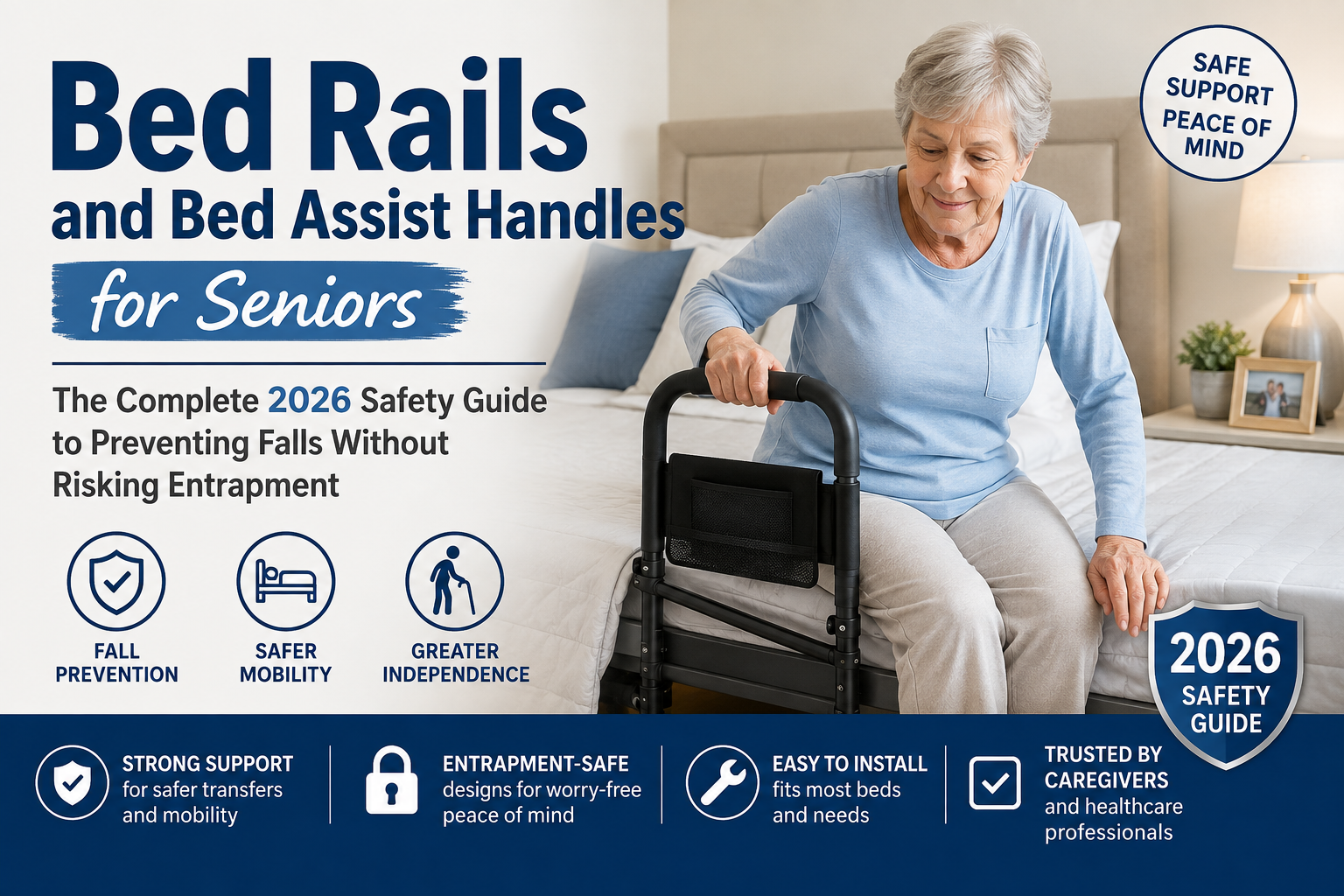
The 2 a.m. Problem
Ruth is 81. She sleeps in the same bed she has slept in for thirty years, and until last winter she got in and out of it without a second thought. Then a bout of pneumonia and two weeks of mostly lying down left her legs weaker than she wanted to admit, and the simple act of swinging them over the edge and standing up in the dark became the most dangerous thing she did all day.
Her son Michael learned this the way most families do: with a phone call. His mother had gotten up at 2 a.m. to use the bathroom, sat up too fast, felt the room tilt, and reached for something to hold onto. There was nothing there. She slid off the edge of the mattress and ended up on the floor between the bed and the nightstand, unhurt but stuck, and stayed there until morning because her phone was across the room.
What Ruth needed was not complicated. She needed something solid to grab on the way up, and something to lean on while her blood pressure caught up with her. A bed assist handle would have given her both. But here is the part families rarely hear until it is too late: the wrong bed rail, chosen for the wrong person, can be far more dangerous than no rail at all. This guide is about getting that choice right.
First, the Hard Truth: Bed Rails Carry a Real Risk
Most product guides bury the safety conversation at the bottom. We are putting it first, because with bed rails it is the whole ballgame.
A bed rail creates gaps: between the bars, between the rail and the mattress, and between the end of the rail and the headboard. A person who slides into one of those gaps and cannot get out can be trapped by the neck or chest. This is not a rare theoretical concern. The U.S. Consumer Product Safety Commission has issued repeated warnings about adult portable bed rails, and the numbers are sobering: nine recalls of adult portable bed rails since 2021, plus multiple product warnings, together affecting more than three million units and linked to at least eighteen reported deaths. In 2026 alone, additional recalls were announced, including roughly 122,000 units from one brand tied to two fatal entrapments of men in their nineties.
The people most at risk are exactly the people families are often most tempted to protect with a rail: older adults who are frail, confused, or have dementia, and who may slide down or try to climb over. That is the paradox at the heart of this product category, and it is why the questions who is this for and does it fit this bed matter more than price or brand.
The good news is that this risk is manageable. A mandatory federal safety standard for adult portable bed rails took effect in 2023, so rails sold today must meet defined dimensional limits. If you buy a compliant product, match it to the right person, and check the gaps yourself, a bed rail becomes what it is supposed to be: a fall-prevention aid, not a hazard.
The FDA Seven Zones of Entrapment (and the Two Numbers to Memorize)
The FDA and the Hospital Bed Safety Workgroup mapped out seven specific spaces in and around a bed where a person can become trapped. You do not need to memorize all seven, but understanding them turns an abstract warning into something you can actually inspect.
- Zone 1 — within the rail itself, between the bars
- Zone 2 — under the rail, between rail supports
- Zone 3 — between the rail and the mattress
- Zone 4 — under the rail at the very ends
- Zone 5 — between split rails
- Zone 6 — between the end of the rail and the headboard or footboard
- Zone 7 — between the headboard or footboard and the mattress end
Zones 1 through 4 are where roughly 80 percent of reported entrapments happen, and they are the ones the FDA gives measurable limits for. Here are the two numbers worth remembering when you inspect a setup:
- Any opening a head could pass through (Zones 1, 2, and 3) should be less than 4¾ inches (120 mm).
- The wedge-shaped space under the rail (Zone 4) should be less than 2⅜ inches.
The practical test is simple. Once the rail is installed, take a rigid cone or a similarly sized object and check every gap: between the bars, between the rail and the mattress along its whole length, and at both ends. If your fist or a small head could fit into a gap, the setup is unsafe and needs a firmer mattress, a mattress that fits the frame more snugly, gap fillers, or a different rail. A gap between the rail and a too-soft or too-small mattress is the single most common danger, because the mattress compresses under body weight and the gap grows.
What a Bed Rail Actually Is — and the Four Types
Bed rail is a broad term covering four fairly different products that solve overlapping but distinct problems. Choosing the right type is more important than choosing the right brand.
1. Bed Assist Handles (Single-Side Grab Bars)
This is the type most seniors actually need, and the one families most often overlook. A bed assist handle is a single rigid bar or looped handle, usually mounted on one side, that gives you something solid to push against as you sit up and stand. It does not enclose the bed. Because it is a handhold rather than a barrier, it carries far less entrapment risk than an enclosure rail, and it directly solves Ruth's problem: a stable point to rise from.
The Home Bed Assist Handle Rail (M-Rail), about $88.70, is a representative example. It slides under the mattress, anchors to the bed frame, and provides a strong horizontal grip at the edge of the bed for sitting up and standing. For an alert adult who is mainly weak or unsteady, this is often the safest and most useful choice on the whole list.
2. Bed Canes
A bed cane is a compact, floor-independent handle that mounts under the mattress and rises beside the bed like the top of a cane, often with a small pouch for a phone or glasses. It is even less obtrusive than an assist rail and travels well. The Bedcane with Organizer by Stander is the classic example (check current availability). Bed canes suit people who need a single, discreet handhold and have good judgment and body control.
3. Half-Length Bed Rails
Half-length rails run along the upper half of the bed, next to the torso and hips. They serve double duty: a barrier that reminds a person where the edge is, and a grab surface for repositioning and rising. The key safety feature to look for is a no-gap design, which closes the space between the rail and the headboard. The Half-Length Bed Rails, No-Gap Style (pair), about $94.24, are built specifically to eliminate the Zone 6 gap that causes some of the worst entrapments.
4. Full-Length Hospital Bed Rails
Full-length rails span most of the bed and are designed to attach to a hospital-style bed frame. They are appropriate in a clinical or home-care setting where a person needs a continuous barrier and is being repositioned by a caregiver. The Full-Length Hospital Bed Rails (pair), about $136.96, pair with a home hospital bed. Important: full-length rails on both sides can function as a physical restraint and raise both entrapment risk and the risk of a person climbing over the top and falling from a greater height. They should be used under professional guidance, not as a default.
Type Comparison at a Glance
| Type | Main Job | Entrapment Risk | Best For |
|---|---|---|---|
| Bed assist handle | Help rising and sitting up | Low | Alert adults who are weak or unsteady |
| Bed cane | Single discreet handhold | Low | Independent seniors, travel |
| Half-length rail | Edge awareness plus grip | Moderate (choose no-gap) | Repositioning, mild roll risk |
| Full-length hospital rail | Continuous barrier | Higher (professional use) | Home-care beds with caregiver |
Who a Bed Rail Is Right For
A bed rail or assist handle helps most when the specific problem is one of these:
- Weakness or unsteadiness when rising — the person can stand once up but needs a solid point to push from
- Recovery from surgery or illness — temporary deconditioning after a hospital stay, a joint replacement, or an infection
- Repositioning difficulty — trouble rolling over or scooting up in bed, where a rail provides leverage
- Mild roll-off risk — a person who occasionally drifts toward the edge but is otherwise aware and in control
- Orthostatic dizziness — needing something to hold while blood pressure adjusts on standing
Who Should Not Use One — or Only With Professional Guidance
This section is the most important in the article. A rail is the wrong tool, or a supervised-only tool, when:
- The person has dementia, delirium, or significant confusion. Rails are associated with the highest entrapment danger in exactly this group, and a confused person may try to climb over and fall from higher up. An occupational-therapy assessment is essential before any rail is used.
- The person is agitated or restless in bed. Thrashing increases the chance of sliding into a gap.
- The person is small or very thin. Smaller bodies fit through smaller gaps, so standard dimensional limits may not protect them.
- The person cannot lower the rail or call for help. A rail that cannot be released by the user can become a trap.
- The goal is really to keep someone in bed. Using a rail as a restraint is both dangerous and, in care settings, regulated. The right answer is usually a lower bed and a floor mat, not a taller barrier.
If any of these apply, talk to a clinician about alternatives before buying a rail. We cover the best ones below.
How to Choose and Fit a Bed Rail Safely
Getting the fit right is where safety is won or lost. Work through these steps in order.
Step 1: Match the Rail to the Bed
An assist handle or portable rail must be rated for your bed type and mattress. Platform beds, adjustable beds, and beds with thick pillow-top mattresses all change how a rail anchors. Confirm compatibility before buying, and never force a hospital-bed rail onto a residential frame it was not made for.
Step 2: Check the Mattress
A soft or undersized mattress is the hidden cause of most dangerous gaps. The mattress should fill the frame edge to edge and be firm enough that it does not compress into a wide gap when the person leans on the rail. If the mattress is too small, replace it or add a snug filler before adding a rail.
Step 3: Measure Every Gap
After installation, inspect with weight on the mattress, not on an empty bed. Verify that no gap between bars, along the mattress, or at the rail ends exceeds the FDA limits (under 4¾ inches for head-sized openings, under 2⅜ inches for the wedge under the rail). Push on the mattress to simulate body weight and re-check.
Step 4: Test the Release and the Grip
The user should be able to reach, grip, and — for rails that lower — release the rail without help. A handhold that is too high, too low, or too far back is a handhold that will not get used.
Step 5: Add Padding Where Needed
Gap fillers and rail bumper pads close small spaces and cushion hard edges. The Side Bed Rail Bumper Pads (pair), about $75.86, wrap full-length rails to reduce both bruising and the size of openings.
Does Medicare Cover Bed Rails? The Honest Answer for 2026
The distinction here saves people from an unpleasant surprise at checkout.
Medicare Part B covers bed rails only when they are part of, or an accessory to, a Medicare-approved hospital bed that has been deemed medically necessary. If a person qualifies for a home hospital bed and a physician certifies the rails as medically necessary, the side rails are covered along with the bed as durable medical equipment. In that case you pay 20 percent of the Medicare-approved amount after meeting the Part B deductible, which is $283 in 2026.
Standalone, detachable bed rails and assist handles for an ordinary residential bed are generally not covered. Medicare treats those as add-ons to regular furniture rather than DME. So the affordable assist handle that solves most people's problem is usually an out-of-pocket purchase — which, at under a hundred dollars for many models, is often less than a single coinsurance bill would be anyway.
Other routes worth checking: Medicare Advantage plans sometimes include supplemental home-safety benefits, some Medicaid waiver programs cover safety equipment, the VA provides equipment for eligible veterans, and a rail purchased with a letter of medical necessity is typically an eligible HSA or FSA expense. Always get the physician order first and call your plan before you buy.
Bed Rail Costs in 2026
| Option | Typical Cost | Makes Sense When |
|---|---|---|
| Bed cane | $60–$130 | One discreet handhold; travel |
| Bed assist handle | $80–$150 | Weak or unsteady but alert adults |
| Half-length rails (pair) | $90–$200 | Repositioning plus edge awareness |
| Full-length hospital rails (pair) | $130–$300 | Home hospital bed, caregiver present |
| Bumper pads / gap fillers | $40–$90 | Closing gaps and cushioning edges |
Prices shown are typical 2026 market ranges; specific product prices quoted in this article were current at the time of writing and may change. Browse current options in the beds and accessories collection and the broader bedroom aids collection.
Using a Bed Rail Safely, Every Night
- Re-check the gaps periodically. Mattresses soften and shift over time, and a safe gap can slowly widen. Inspect monthly.
- Never use a recalled or non-compliant rail. If you already own a portable rail, look up the brand and model against current CPSC recalls before trusting it.
- Keep a phone or a medical alert device within reach on the bed, not across the room — the very failure that left Ruth on the floor until morning.
- Do not use a rail to confine someone. If a person is trying to get out and cannot safely, that is a signal to reassess, not to add a bigger barrier.
- Combine the rail with good lighting. A motion-activated night light removes the disorientation that causes many nighttime falls.
- Pair rising help with a safe path. A rail gets the person up; a clear, rug-free route and a nearby bedside commode gets them where they are going.
Alternatives When a Rail Is the Wrong Tool
For a confused or high-risk person, the safest strategy often avoids an enclosure rail entirely. Consider these instead, ideally chosen with an occupational therapist:
- Lower the bed. A low bed shortens the fall distance and can remove the need for a barrier. Home hospital beds adjust down; some families use a floor-level mattress.
- Fall mats beside the bed. Cushioned floor mats reduce injury if a person does roll out.
- A bed assist handle instead of an enclosure. A single handhold offers rising support without the trapping gaps of a barrier rail.
- Body-positioning wedges. The 30-Degree Positioning Wedges (pair), about $127.52, hold a person on their side and away from the edge without a hard barrier, and help with pressure relief. See the bed and furniture wedges collection.
- Pressure and skin protection. For anyone spending long hours in bed, review our pressure ulcer prevention guide.
- A monitor or alert. Bed-exit sensors and medical alert systems summon help rather than trying to physically prevent movement.
Frequently Asked Questions
Are bed rails safe for the elderly?
They can be, for the right person, when compliant with the current federal standard and fitted correctly. They are dangerous for people who are confused, agitated, very thin, or unable to free themselves, because of entrapment risk. Always match the rail to the person and check every gap. For higher-risk individuals, an occupational-therapy assessment should come first.
What is bed rail entrapment?
Entrapment is when a person becomes caught in a gap in or around the bed — between the bars, between the rail and mattress, or at the rail ends — and cannot free themselves, risking injury or asphyxiation. The FDA maps seven zones where it can occur; Zones 1 through 4 account for about 80 percent of cases.
What gap sizes are considered safe?
Openings large enough for a head to pass through (Zones 1, 2, and 3) should be under 4¾ inches, and the wedge-shaped space under the rail (Zone 4) should be under 2⅜ inches. Measure with weight on the mattress, since a soft mattress compresses and widens gaps.
Does Medicare pay for bed rails?
Only when the rails are part of, or an accessory to, a Medicare-approved hospital bed that a physician has certified as medically necessary. In that case you pay 20 percent after the Part B deductible ($283 in 2026). Standalone rails or assist handles for an ordinary bed are generally not covered.
What is the difference between a bed rail and a bed assist handle?
A bed rail is a barrier along the side of the bed. A bed assist handle is a single grab bar you push against to sit up and stand. The handle carries much less entrapment risk and is the better choice for most alert seniors whose main problem is rising safely.
Can bed rails be used for someone with dementia?
Only with professional guidance, and often they should be avoided. People with dementia have the highest entrapment risk and may try to climb over a rail and fall from greater height. A lower bed, floor mats, and monitoring are usually safer than an enclosure rail.
Why do bed rails get recalled so often?
Many adult portable bed rails sold before the 2023 federal standard had gaps that allowed entrapment. Since 2021 the CPSC has issued nine recalls and multiple warnings affecting millions of units and linked to at least eighteen deaths. Buy only current, standard-compliant products and check any rail you already own against recall lists.
What kind of mattress do I need with a bed rail?
One that fills the bed frame edge to edge and is firm enough not to compress into a wide gap when leaned on. An undersized or overly soft mattress is the most common cause of a dangerous rail-to-mattress gap.
Can I put a bed rail on an adjustable or platform bed?
Only if the rail is rated for that bed type. Adjustable and platform beds anchor rails differently, and a rail forced onto an incompatible frame can shift or leave gaps. Confirm compatibility before buying.
Are half-length or full-length rails better?
Half-length rails, especially no-gap designs, cover the torso for rising and repositioning while leaving the lower bed open, which lowers some risks. Full-length rails create a continuous barrier suited to hospital-style beds with a caregiver present, but they raise entrapment and climb-over concerns and should be used under professional guidance.
What should I do if my current bed rail was recalled?
Stop using it immediately, follow the manufacturer's recall remedy, and switch to a compliant product. Do not attempt to modify a recalled rail to make it safe.
Is a bed cane enough on its own?
For an alert, reasonably strong senior who just needs one handhold to rise, yes — a bed cane is often enough and less obtrusive than a rail. It is not appropriate for someone at real risk of rolling out of bed or who is confused.
The Takeaway: Support the Person, Not Just the Bed
A bed rail does not make a bed safe by itself. The right choice starts with an honest look at the person. If they are alert and simply need help rising, a bed assist handle or bed cane is usually the safest, most useful, and most affordable answer. If they need edge awareness and repositioning support, a no-gap half-length rail can help. If they are confused, agitated, or frail, the safest path is often a lower bed, floor mats, and monitoring rather than a taller barrier — and always an occupational-therapy assessment first.
Whatever you choose, buy a current standard-compliant product, fit it to a firm, snug mattress, measure every gap, and keep a way to call for help within reach. Done right, the payoff is exactly what Ruth got back: the confidence to stand up in the dark and know something solid is there.
Need Help Choosing the Right Bed Rail or Assist Handle?
AllCare Store carries bed assist handles, bed canes, half-length no-gap rails, full-length hospital bed rails, bumper pads, positioning wedges, and the home hospital beds they attach to. Browse the beds and accessories collection, the bedroom aids collection, the bedroom and bathroom safety collection, and our guides to hospital beds for home use and grab bars and safety rails.
Call 1-888-889-6260 to talk with a specialist about which rail fits your loved one, your bed, and your situation — including entrapment safety and Medicare documentation — or visit AllCareStore.com to browse the full range. Free U.S. shipping, discreet packaging, and 30-day returns on every order.
MEDICAL AND SAFETY DISCLAIMER: This article is for general information only and is not a substitute for professional medical advice or an occupational-therapy assessment. Bed rails are a safety-critical device. Used correctly they help prevent falls; used incorrectly they can cause serious injury or death by entrapment or asphyxiation, especially for people who are confused, agitated, frail, or small in body size. Before adding any rail, ask the person's physician, nurse, or occupational therapist whether a rail is appropriate, and have them check the fit against the bed and mattress. Only use rails that meet the current federal safety standard, follow the manufacturer's instructions exactly, and never modify a rail or use one with a gap it was not designed for. Coverage rules and product availability change; verify current details with your plan and supplier.
This guide was written and reviewed by the AllCare Store editorial team. Safety standards, recall lists, coverage rules, and product pricing change — verify current details with the manufacturer, the CPSC, and your insurer. For personalized advice, consult the person's physician, nurse, or occupational therapist.



