The Six Inches That Change Everything
The gap between a wheelchair and a bed is usually about six inches. For most people that distance is nothing — you stand, you pivot, you sit. But for someone who can't reliably stand, those six inches are a canyon. Crossing them becomes the single most dangerous moment of the day, repeated a dozen times: bed to chair, chair to toilet, chair to car, chair to shower bench. It's where falls happen, where skin tears, and where caregivers wreck their backs trying to lift a full-grown adult across empty air.
Daniel learned this the hard way. His wife had multiple sclerosis, strong arms but legs that no longer held her, and for months he transferred her the only way he knew how: a bear hug, a heave, and a prayer. It worked until the afternoon his grip slipped near the bathroom and they both went down. Nobody broke anything, but the message was clear. When the home-health occupational therapist visited that week, she brought a flat, polished board about the length of a person's arm and showed them how to bridge the gap instead of flying over it. His wife slid across it in three small, controlled movements. No lifting. No canyon. Just a bridge.
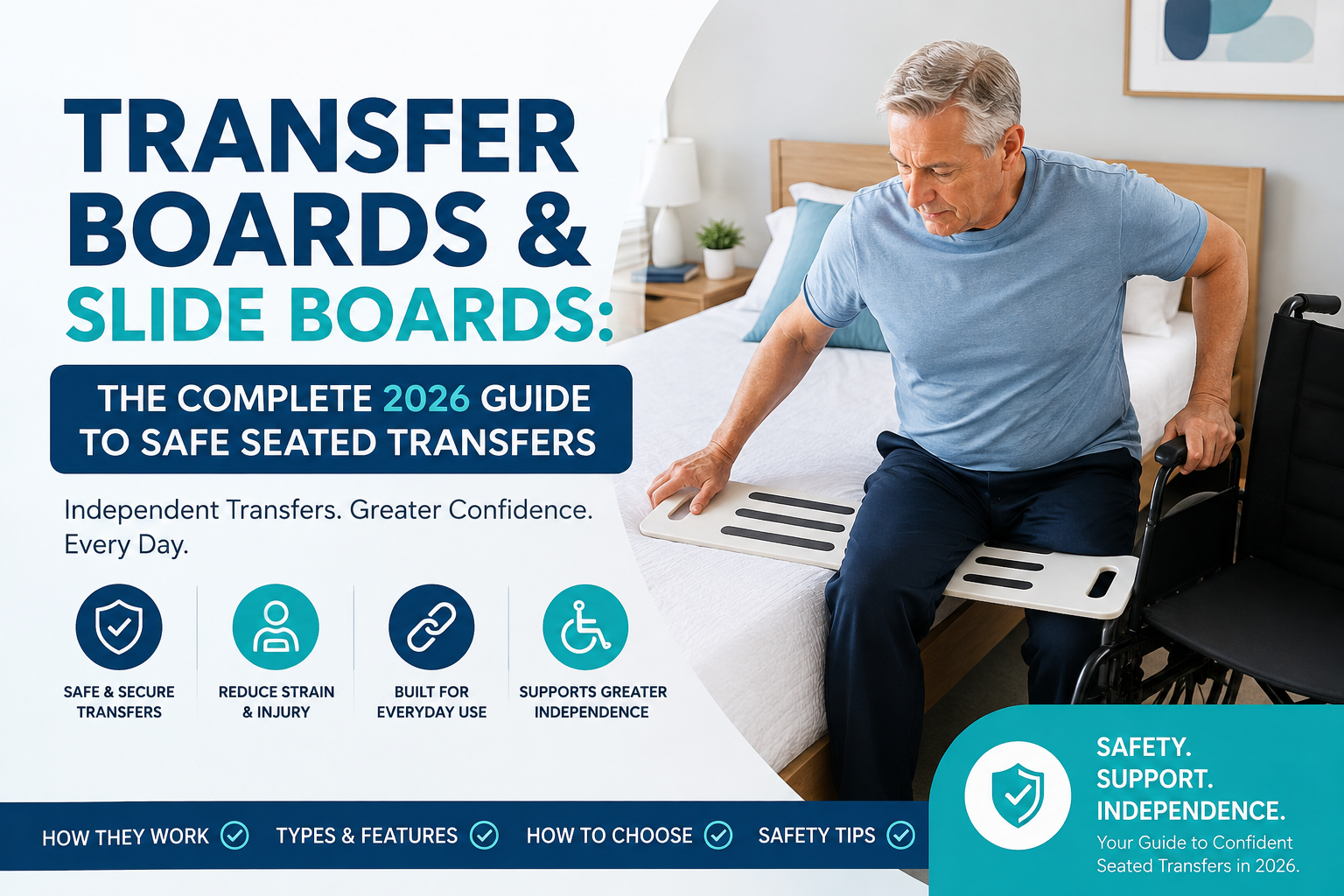
That board is the subject of this guide. A transfer board — also called a slide board or sliding board — is one of the simplest and most underused pieces of equipment in home care. It doesn't lift anyone. It turns a dangerous vertical lift into a safe horizontal slide. For the right person, it's the difference between independence and being hoisted, and between a caregiver's healthy spine and a herniated disc.
What a Transfer Board Actually Is
A transfer board is a smooth, rigid plank — traditionally hardwood, now often laminated wood or medical-grade plastic — that bridges the space between two surfaces of similar height. One end tucks under the person's hip; the other rests on the destination surface. The person then scoots or slides across the board in small increments until they reach the other side. The board carries the weight; the person supplies the movement, and the caregiver guides and steadies rather than lifts.
The key idea is that both surfaces should be roughly level. A transfer board works with gravity across a flat span, not up a hill. That's why it pairs so naturally with an adjustable bed, a wheelchair with removable armrests, and a car seat — anywhere two seats sit at similar heights within reach of each other.
You can see the range of straight boards, curved boards, and sliding-seat systems in the transfer belts, gait belts & transfer boards collection at AllCare Store. The differences come down to three designs, and choosing the right one matters more than any other decision.
The Three Types of Transfer Boards
1. Straight Boards
The classic design: a flat, straight plank, usually 24 to 30 inches long and 8 to 9 inches wide, sometimes with hand cutouts and notches to grip. The person bridges the gap and scoots across in stages. Straight boards are inexpensive, durable, and ideal for level transfers where the two surfaces are close together and there are no obstacles in between. The Premium Heavy-Duty Transfer Board (26 x 8 inch), around $163, is a reinforced, form-laminated example built for home and hospital use.
Best for: people with decent upper-body and trunk strength who can push through their arms.
Watch out for: straight boards require the person to lift-and-scoot, which takes strength and can shear the skin if done by dragging rather than lifting each inch.
2. Curved and Offset Boards
Curved boards bend around obstacles — a wheelchair wheel, a car door frame, a commode — so the two surfaces don't have to be directly side by side. The curve lets the person travel a gentle arc rather than a straight line, which is exactly what many real-world transfers require. They're the practical choice for wheelchair-to-car and tight bathroom transfers.
3. Sliding-Seat Boards
The most advanced design solves the biggest problem with flat boards: friction. A sliding-seat board has a movable disc or seat that glides along a track, so the person sits on the seat and is carried across without dragging their skin along the board at all. This dramatically reduces the effort required and — critically — protects fragile skin from the shearing forces that cause pressure injuries. The Beasy II Board (27.5 inch), about $462, uses exactly this sliding-disc mechanism and is designed for smaller transfer areas like bathrooms.
Best for: people with limited arm strength, anyone with fragile or at-risk skin, and caregivers who need to do most of the guiding themselves.
Watch out for: higher cost and more moving parts to maintain — but for the right person the skin protection alone justifies it.
Quick Comparison
| Type | Best Situation | Skin Protection | Typical Price |
|---|---|---|---|
| Straight board | Level, side-by-side surfaces | Lower (scoot friction) | $30–$170 |
| Curved / offset board | Around wheels, car doors, corners | Lower to moderate | $40–$180 |
| Sliding-seat board | Fragile skin, limited arm strength | High (no dragging) | $300–$600 |
Who Can Safely Use a Transfer Board
A transfer board is the right tool when the person sits in the middle of the mobility spectrum — too weak to stand and pivot safely, but not so weak that they're complete dead weight. Specifically, a board works well for someone who:
- Has reasonable upper-body and trunk control — enough to hold themselves upright while seated and, ideally, push through their arms
- Cannot bear full weight on their legs to stand and pivot, but doesn't need to
- Can follow directions and cooperate with the transfer
- Is transferring between surfaces of similar height — bed, wheelchair, commode, shower bench, car seat
Common users include people with spinal cord injuries, lower-limb amputations, advanced arthritis, multiple sclerosis, and those recovering from leg or hip surgery who are non-weight-bearing for a period. It's also a core independence tool: many people use a board to transfer themselves, no caregiver required.
When a Board Is the Wrong Choice
This matters as much as the sales pitch. Reconsider — or ask a therapist first — when:
- The person has no trunk control or is complete dead weight. A board needs the person to hold themselves upright and contribute to the movement. Someone who can't do either needs a mechanical or sit-to-stand lift instead. The AX05 sit-to-stand lift (about $439) is one option for that situation, and our patient transfer equipment guide covers lifts in depth.
- The skin is fragile, broken, or has a pressure injury in the transfer area. Straight boards shear skin. If a board is still appropriate, use a sliding-seat design and see our guide to pressure ulcer prevention.
- The two surfaces are very different heights. A board is not a ramp; forcing an uphill transfer is unsafe. Adjust the bed to match the chair first.
- The person is combative or unpredictable due to cognitive impairment, to the point that a controlled slide isn't possible.
- The person's weight exceeds the board's rating. Never guess — see sizing below.
How to Do a Transfer Board Transfer, Step by Step
This is a general description for education only. Have an occupational or physical therapist teach and check your specific technique before relying on it.
- Set up the surfaces. Position the wheelchair at a slight angle (about 20–30 degrees) to the destination, lock the brakes, and remove the near armrest. Match the heights as closely as possible — raise or lower an adjustable bed to meet the chair.
- Remove obstacles. Swing away or remove footrests, move clothing and tubing clear, and make sure the destination is clear and stable.
- Place the board. Have the person lean away while you slide one end of the board well under their hip — not just under the thigh — with the other end resting solidly on the destination surface. A third to half of the board should be under them.
- Add a gait belt if a caregiver is assisting. A gait or transfer belt gives you a safe handhold at the waist so you never pull on an arm.
- Move in small increments. The person leans slightly forward and, pushing through their arms (fists on the board or the seat, not fingers over the edge), lifts and scoots — or, on a sliding-seat board, simply glides — a few inches at a time. Small moves, not one big lunge.
- Guide, don't lift. The caregiver holds the belt and steadies, blocking the person's knees with their own if needed to keep the legs from buckling. Keep your back straight and your knees bent.
- Finish and remove the board. Once the person is fully and stably seated on the destination, have them lean away again and slide the board out. Confirm they're secure before you let go.
The cardinal rule: lift-and-move, never drag. Dragging the skin across a board is what causes shear injuries and skin tears. If the person can't lift their own weight off the board between scoots, that's the signal to switch to a sliding-seat board or a lift.
Weight Capacity and Sizing
Two numbers decide whether a board is safe: its length and its weight rating.
Length should match the gap plus enough overlap to sit securely on both surfaces. Short boards (about 24 inches) suit tight, close transfers like wheelchair-to-commode; longer boards (28–30 inches and up) handle wider gaps like wheelchair-to-car. Too short and the board can slip off an edge mid-transfer — the most common cause of board-related falls.
Weight capacity is non-negotiable. Standard boards typically support 300 to 440 pounds; bariatric boards go higher. Always choose a board rated comfortably above the user's weight, never one you're sitting at the limit of — an overloaded board can crack, and it will do so at the worst possible moment. Check the specific product's stated capacity before you buy.
Width and surface matter too: a wider board feels more secure, and a smooth, sealed, splinter-free surface is essential. Inspect wooden boards regularly for cracks and rough spots.
Does Medicare Cover Transfer Boards?
Sometimes. A transfer board can qualify as durable medical equipment when a physician documents medical necessity — typically that the person is unable to transfer safely without it. When it qualifies, Medicare Part B generally pays 80% of the approved amount after your deductible, and you pay the remaining 20%. Coverage is not automatic, and simpler wooden boards are inexpensive enough that many families just purchase them outright.
To pursue coverage you'll generally need a physician's order, documentation of the functional need, and a Medicare-enrolled supplier that accepts assignment. Transfer boards are also typically an eligible HSA or FSA expense with a letter of medical necessity, which for many buyers is the simpler route. As always, verify current rules with your plan before you purchase — coverage details change and vary by region.
What Transfer Boards Cost in 2026
| Option | Typical Price | Makes Sense When |
|---|---|---|
| Basic wooden straight board | $30–$70 | Strong arms, level side-by-side transfers |
| Premium laminated / notched board | $120–$180 | Daily use, heavier-duty needs |
| Curved / offset board | $40–$180 | Around wheels, car doors, tight corners |
| Sliding-seat board (e.g., Beasy) | $300–$600 | Fragile skin, limited arm strength |
| Bariatric transfer board | $80–$250 | User weight above standard ratings |
Prices shown are typical 2026 ranges; specific product prices quoted in this article were current at the time of writing and may change.
Care, Cleaning, and Safety Checks
- Inspect before every use. Look for cracks, splinters, warping, and worn edges on wooden boards, and check the sliding mechanism on seat boards. A cracked board is a fall waiting to happen — retire it immediately.
- Clean between uses, especially if the board is shared or used near the toilet or shower. Sealed and plastic boards wipe down with disinfectant; keep wooden boards dry and sealed.
- Keep the surface friction-appropriate. Straight boards should be smooth enough to slide but not so slick the person shoots off. Sliding-seat tracks should move freely.
- Store it flat and dry. Warping ruins a board's fit against the surfaces.
- Protect the skin. If you ever see redness or a skin tear after transfers, stop dragging and reassess — switch to a sliding-seat board and review pressure injury prevention.
The Board Is One Piece of a Safer Transfer
A transfer board works best inside a complete setup. Pair it with a gait or transfer belt so the caregiver always has a safe handhold, a wheelchair with removable armrests and swing-away footrests, an adjustable bed to level the heights, and — for the transfers a board can't safely handle — a lift. If standing is the specific barrier rather than transferring, a lift chair may be the better answer. And every caregiver managing transfers alone should keep a medical alert device within reach for the day one goes wrong.
Browse the full range in the transfer belts, gait belts & transfer boards collection, the aids to daily living collection, and the broader mobility aids collection.
Frequently Asked Questions
What is a transfer board used for?
It bridges the gap between two seated surfaces of similar height — such as a wheelchair and a bed, toilet, shower bench, or car seat — so a person who can't stand safely can slide across in small steps instead of being lifted. It converts a risky vertical lift into a controlled horizontal slide.
Who should not use a transfer board?
Anyone with no trunk control or who is complete dead weight (they need a lift), anyone with broken or fragile skin in the transfer area unless using a sliding-seat board, situations where the two surfaces are very different heights, and anyone over the board's weight rating. Always confirm suitability with a therapist.
What is the difference between a straight board and a Beasy-style board?
On a straight board the person lifts and scoots their own body across a fixed surface, which takes arm strength and can shear the skin if done by dragging. A Beasy-style sliding-seat board has a movable seat or disc that carries the person along a track, so the skin never drags — much easier and far safer for fragile skin, at a higher price.
How much weight can a transfer board hold?
Standard boards typically support 300 to 440 pounds; bariatric models go higher. Always choose one rated comfortably above the user's weight and check the specific product's stated capacity before buying.
Do you need a gait belt with a transfer board?
When a caregiver is assisting, yes — a gait or transfer belt gives you a secure handhold at the waist so you guide and steady without ever pulling on the person's arm or shoulder. People who transfer themselves independently may not need one.
How do you keep the skin safe during a board transfer?
Lift-and-move in small increments rather than dragging, keep the board smooth and splinter-free, and switch to a sliding-seat board if the skin is fragile or you see any redness or tearing. Dragging across a board is the main cause of shear injuries.
Does Medicare pay for a transfer board?
It can, when a physician documents that the person cannot transfer safely without it and you buy from a Medicare-enrolled supplier. Coverage isn't automatic; basic boards are inexpensive enough that many families purchase them outright, and they're typically HSA/FSA eligible. Verify current rules with your plan.
What length transfer board do I need?
Match the board to the gap plus enough overlap to rest securely on both surfaces. Shorter boards (about 24 inches) suit tight transfers; longer boards (28–30 inches or more) handle wider gaps like wheelchair-to-car. Too short and the board can slip off an edge.
Can a person use a transfer board by themselves?
Yes — many people with good upper-body strength and trunk control transfer independently with a board. An occupational therapist can teach the safest self-transfer technique for the person's specific situation.
Can a transfer board be used to get into a car?
Yes, and a curved or offset board is often best for it because it can bend around the door frame. Match the seat heights as closely as possible and lock everything that can move before starting.
The Takeaway
A transfer board doesn't restore strength or replace a lift. What it does is turn the most dangerous six inches in a person's day — the empty gap between two seats — into a solid bridge. For someone with the arm strength and trunk control to use it, that bridge means safer transfers, protected skin, more independence, and a caregiver whose back is still working next year.
Pick the design that matches the person's skin and strength, size it to the gap and the weight, pair it with a gait belt, level the surfaces, and always lift-and-slide rather than drag. Have a therapist show you once. Then let the board do what it does best: carry the weight so nobody has to lift it.
MEDICAL DISCLAIMER: This article is for general educational purposes only and is not a substitute for hands-on training or professional medical advice. Whether a transfer board is safe — and how to use it correctly — depends on the specific person's strength, trunk control, skin condition, weight, and diagnosis. Ask a physical or occupational therapist to assess the person and demonstrate the technique before you rely on any transfer method. If a transfer feels unsafe, stop and get help. If a fall occurs and the person cannot get up, has hit their head, or has new pain, seek medical attention promptly.
Not Sure Which Transfer Board Fits? Let's Help.
AllCare Store carries straight boards, curved and offset boards, sliding-seat boards, and bariatric models — plus the gait belts, transfer slings, and lifts that complete a safe transfer setup. Browse the transfer belts, gait belts & transfer boards collection, or explore the aids to daily living and mobility aids collections.
Call 1-888-889-6260 to speak with a specialist about board length, weight capacity, and safe transfer technique for your situation, or visit AllCareStore.com. Free U.S. shipping, discreet packaging, and 30-day returns on every order.
This guide was written and reviewed by the AllCare Store editorial team. It is educational and not a substitute for hands-on training or medical advice. Ask a physical or occupational therapist to demonstrate safe transfer technique before relying on any device.