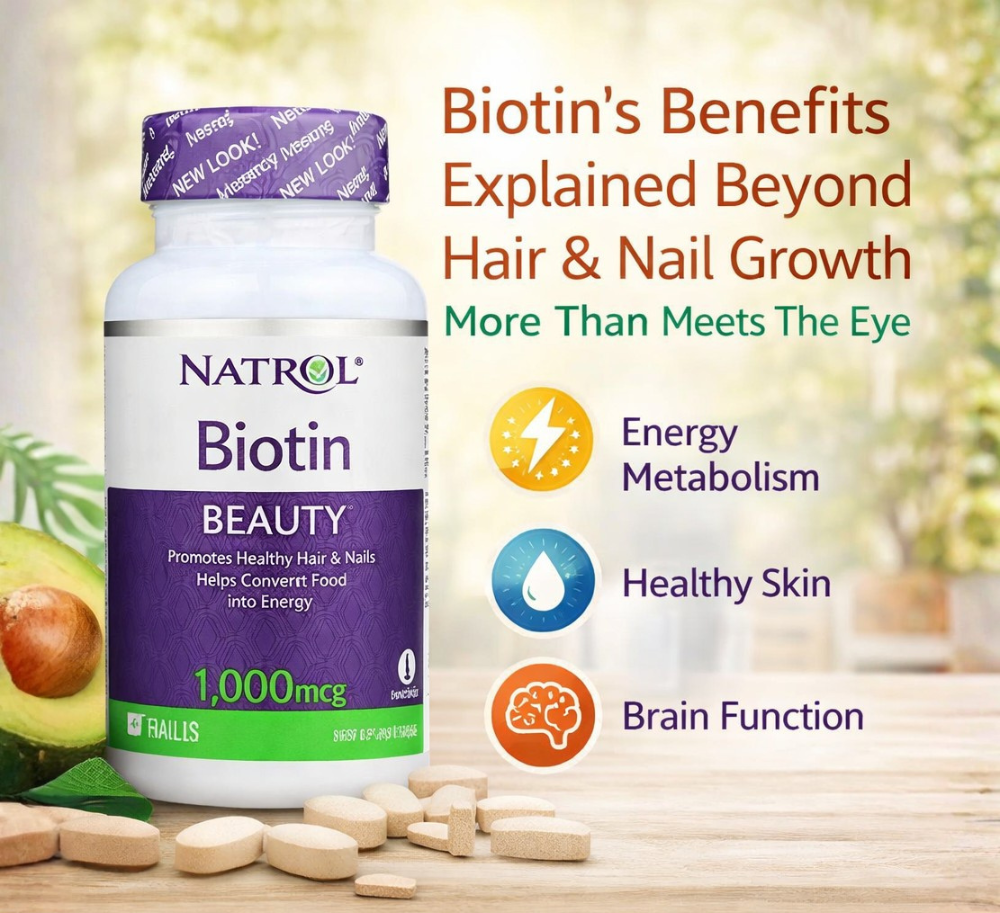
Biotin is marketed almost entirely on appearance — thicker hair, stronger nails, better skin. That framing is a marketing decision, not a biological one. Biotin's actual job in the human body is a piece of metabolic plumbing, and it is a genuinely interesting one: it is the required cofactor for a small family of enzymes called carboxylases, without which your body cannot build fat, cannot make glucose between meals, and cannot fully break down certain amino acids.
Understanding that machinery is useful for a practical reason. It explains why biotin matters, and it also explains why swallowing more of it than your enzymes can use does not produce more of anything. If you want the practical companion pieces, see our guides on who is actually at risk of biotin deficiency and on biotin dosage, safety and drug interactions.
The Core Idea: Biotin Is A Carbon Dioxide Handle
Most vitamins act as helper molecules that let a specific enzyme do a specific chemical trick. Biotin's trick is carboxylation — attaching a carbon dioxide molecule onto another compound to make it reactive enough to enter the next step of a pathway.
Mechanically, biotin gets covalently attached to its enzyme by another enzyme called holocarboxylase synthetase. Once bound, the biotin acts as a swinging arm: it picks up a bicarbonate-derived carbon, swings across the enzyme, and delivers it to the target molecule. When the enzyme is eventually broken down, a second enzyme called biotinidase clips the biotin free so it can be reused. That recycling loop is a large part of why the daily requirement is so small — the body is not consuming biotin so much as passing it around.
The Five Carboxylases And What Each One Is For
Acetyl-CoA Carboxylase 1 And 2 — Building And Burning Fat
ACC1 sits in the cytosol and performs the committed first step of fatty acid synthesis, converting acetyl-CoA into malonyl-CoA. Every fatty acid your body makes from scratch starts here. ACC2 sits at the mitochondrial surface and its malonyl-CoA product acts as a brake on fat burning, controlling how much fatty acid gets shuttled into mitochondria for oxidation.
This is the pair that connects biotin to skin and hair in a way that is actually mechanistic rather than promotional. Fatty acid synthesis supplies the lipids that build the skin barrier and the cell membranes of rapidly dividing tissue — which is exactly what hair follicles and nail matrix are. When biotin runs genuinely short, these fast-turnover tissues show it first. That is the real link, and it is a deficiency story, not an enhancement story.
Pyruvate Carboxylase — Making Glucose Between Meals
This enzyme converts pyruvate into oxaloacetate, the entry step of gluconeogenesis, the pathway that lets your liver manufacture glucose when you have not eaten recently. The same reaction also tops up the citric acid cycle by replacing intermediates that have been drained off for other uses — a housekeeping function called anaplerosis that keeps energy production running smoothly.
Propionyl-CoA Carboxylase — Clearing Odd-Chain Breakdown Products
Breaking down the amino acids isoleucine, valine, methionine and threonine, plus odd-chain fatty acids and cholesterol side chains, generates propionyl-CoA. This enzyme converts it into something the citric acid cycle can use. Without enough biotin, propionyl-CoA backs up, which is why raised odd-chain fatty acids and certain organic acids in urine are among the biochemical markers of biotin depletion.
3-Methylcrotonyl-CoA Carboxylase — Handling Leucine
This one handles a specific step in leucine breakdown. When biotin is short, its substrate accumulates and is excreted as 3-hydroxyisovaleric acid — one of the more sensitive early laboratory indicators that biotin status is falling, and it rises before any visible symptom appears.
Beyond Enzymes: Biotin And Gene Expression
Carboxylase work is biotin's established job, but there is a second area under investigation. Biotin can be attached to histones, the proteins that DNA winds around, and histone modification is one of the ways cells control which genes are switched on. Research has also linked biotin status to the expression of genes involved in glucose handling and immune function. This is an active and unsettled area — interesting, but not yet a basis for any health claim.
Why This Explains The Limits Of Supplementation
Here is the practical payoff. Enzymes are saturable. Once every copy of your five carboxylases has a biotin attached and is running at capacity, additional biotin has nothing to do. It circulates and is excreted in urine, because biotin is water-soluble and the body does not stockpile it.
That is why the picture looks the way it does in practice:
- If you are deficient, restoring biotin restores carboxylase function, and the tissues that were struggling — skin, hair, nails, energy metabolism — recover.
- If you are not deficient, adding a high-dose tablet does not make carboxylases work harder than capacity, and there is no mechanism by which it would grow hair faster.
This is the honest version of what supplement labels compress into "supports healthy hair, skin and nails". It supports them by preventing a shortfall, not by pushing past sufficiency. Our piece on whether biotin supplements really improve hair growth works through what that means for realistic expectations.
How Biotin Fits With The Rest Of The B Vitamins
Biotin is B7, one of eight B vitamins, and its pathways interlock with the others. Pyruvate carboxylase feeds a cycle that depends on thiamine and riboflavin-derived cofactors. Propionyl-CoA metabolism hands off to a B12-dependent enzyme immediately downstream — so a B12 problem and a biotin problem can produce overlapping biochemical findings. Fat synthesis draws on pantothenic acid as the backbone of coenzyme A.
In other words, no B vitamin works alone. If you are thinking about B vitamins generally rather than biotin specifically, our reference guide to what each B vitamin does covers the full set, and our comparison of liquid versus pill B-complex covers delivery formats. You can browse the range in vitamins and supplements or the broader vitamins and minerals section.
The Short Version
- Biotin is a cofactor for five carboxylase enzymes, not a hair ingredient.
- Those enzymes handle fat synthesis, glucose production and the breakdown of specific amino acids.
- The skin, hair and nail connection is real but runs through lipid synthesis in fast-turnover tissue — it shows up as a deficiency sign, not an enhancement lever.
- Biotin is recycled by biotinidase, which is why daily needs are measured in micrograms.
- Enzyme saturation means excess intake is excreted, not stored or converted into extra benefit.
Before you start a supplement: talk to your doctor or pharmacist, especially if you are pregnant, breastfeeding, taking prescription medication or managing a health condition. This article is general educational information about how a nutrient works. It is not medical advice, and biotin is not a treatment for any disease.