The Tingle That Gave Her an Evening Back
Diane is 61 and has lived with a cranky lower back for the better part of a decade. Nothing dramatic on the scans, just the kind of deep, grinding ache that shows up after she stands at the kitchen counter too long or sits through a movie. For years the routine was the same: an over-the-counter pain reliever after dinner, a heating pad, and an early, restless night. She did not love taking a pill every single evening, and neither did her doctor.
At a physical therapy appointment for something unrelated, the therapist placed two small sticky pads on either side of her spine, clipped on some wires, and slowly turned a dial. Diane felt a gentle, buzzing tingle spread across her lower back, like a tiny massage that never got tired. Twenty minutes later the ache had faded into the background for the first time in ages, and it stayed quiet for a couple of hours. "That's a TENS unit," the therapist said. "You can use one just like this at home."
That is the honest promise of a TENS unit, and also its honest limit. It did not fix Diane's back. It did not make the underlying wear-and-tear disappear. What it did was give her a drug-free tool she could reach for on a bad evening, turn the volume of the pain down enough to move, stretch, and get comfortable, and go to bed without another pill. For a lot of people living with persistent aches, that trade is exactly what they are looking for. This guide explains what a TENS unit really is, how it works, who it helps, how to use one safely, and how to choose the right one.
What a TENS Unit Actually Is
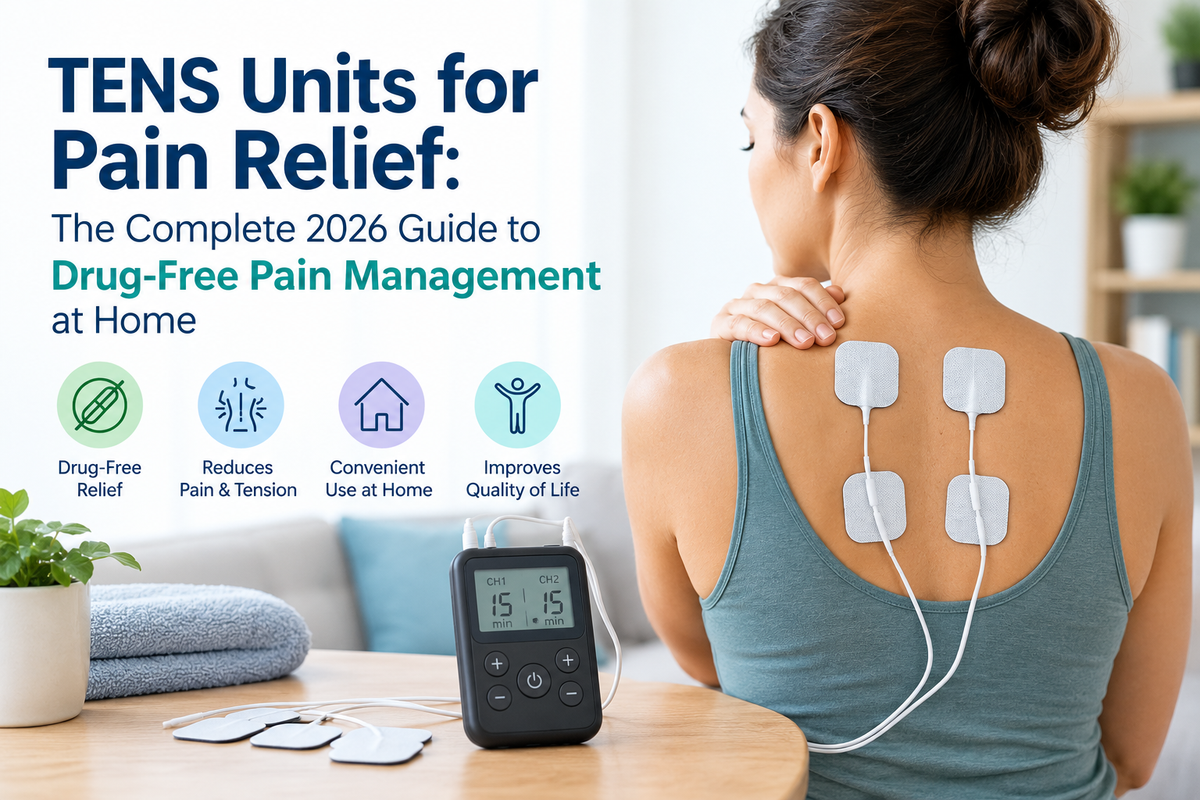
TENS stands for transcutaneous electrical nerve stimulation. Broken down, that simply means sending a mild electrical current across the surface of the skin (transcutaneous) to stimulate the nerves underneath. A TENS unit is a small, battery-powered device, about the size of a phone or smaller, that connects by thin wires to sticky electrode pads you place on your skin near the area that hurts. When you turn it on, it delivers gentle pulses of current that you feel as a tingling, buzzing, or light tapping sensation.
It is a symptom tool, not a cure. A TENS unit is designed to make pain more bearable while your body heals or while you manage a long-term condition. It sits comfortably alongside the other drug-free options in a modern pain toolkit, from a good heating pad and hot and cold therapy to supportive bracing and gentle movement with therapy bands. You can see the full range of stimulation devices in the electrotherapy collection.
How Does a TENS Unit Work?
A TENS unit relieves pain through two well-studied mechanisms, and most units let you target one or the other by changing the settings.
1. It Closes the "Pain Gate"
The most familiar explanation is the gate control theory of pain. Your spinal cord acts like a gate that pain signals must pass through on their way to the brain. When you deliver a rapid, comfortable buzz of electrical stimulation to the same area, you flood those nerve pathways with harmless sensory signals. The nervous system can only pay attention to so much at once, so the gentle tingle effectively crowds out the pain messages, partly closing the gate. This is why rubbing a banged elbow makes it feel better, the TENS unit is doing a more precise, tireless version of the same thing. This mode, called conventional or high-frequency TENS, works quickly and is what most people use day to day.
2. It Prompts Your Body's Own Painkillers
Set to a slower, stronger pulse, called acupuncture-like or low-frequency TENS, the unit encourages the body to release endorphins, its natural opioid-like painkillers. This mode takes longer to kick in, twenty to thirty minutes, but the relief can outlast the session by a while. Some people alternate the two modes, using the fast tingle for quick relief and the slower setting for longer-lasting effect.
It is worth being honest about the science: research on TENS is genuinely mixed. Some studies show meaningful relief, others show benefits close to placebo, and results vary a lot from person to person and condition to condition. What most clinicians agree on is that TENS is low-risk, drug-free, and worth trying, because when it works for you, it works, and the only real way to know is to give it a fair trial.
TENS vs. EMS: Two Very Different Jobs
Shoppers constantly confuse TENS with EMS, and many units on the market actually do both, so it helps to be clear. TENS stimulates nerves to reduce the sensation of pain. EMS, electrical muscle stimulation, stimulates the muscles themselves to contract, which is used to strengthen weak muscles, re-educate them after injury or surgery, reduce spasm, and improve circulation. A combination TENS/EMS unit gives you both toolsets in one device, which is handy if you are managing pain and rebuilding strength at the same time, for example during recovery from a knee replacement.
| Feature | TENS | EMS |
|---|---|---|
| Main goal | Reduce pain | Contract and strengthen muscle |
| Targets | Sensory nerves | Motor nerves and muscle |
| What you feel | Tingling, buzzing | Muscle twitch or contraction |
| Best for | Chronic and acute pain | Rehab, muscle re-education, spasm |
What TENS Is Commonly Used For
People reach for a TENS unit for a wide range of nagging and chronic pains. It tends to be most useful for well-localized musculoskeletal and nerve-related pain, including:
- Chronic lower back pain, one of the most common reasons people buy a unit, often paired with a back support and gentle core work.
- Arthritis and osteoarthritis pain, especially in the knees, hands, and hips. See our complete guide to arthritis pain relief for the bigger picture.
- Sciatica and other nerve pain that radiates down a limb.
- Diabetic peripheral neuropathy, the burning or tingling nerve pain in the feet and legs, used only with a doctor's guidance because of reduced sensation.
- Neck and shoulder tension, and pain related to rotator cuff and shoulder problems.
- Fibromyalgia and general muscle aches.
- Period pain and labor, where TENS is a well-established drug-free option (during pregnancy, only under professional guidance).
- Post-exercise soreness and muscle recovery, alongside tools like foam rolling.
TENS is generally a poor fit for widespread, whole-body pain, for headaches and migraines (the head and neck have important placement restrictions), and for any pain that has not yet been diagnosed.
How to Use a TENS Unit, Step by Step
Using a TENS unit is simple once you learn the rhythm, but a few habits make the difference between disappointing and genuinely helpful results.
- Start with clean, dry, intact skin. Wash and dry the area so the pads stick well and the current spreads evenly. Never place pads on broken, irritated, or numb skin.
- Place the pads around the pain, not on a forbidden zone. Position the electrodes on either side of the painful area, or bracketing it, so the current flows through the sore region. Keep pads at least an inch apart and follow the placement diagram for your specific pain. When in doubt, ask a physical therapist to mark good spots the first time.
- Connect the leads and start low. Turn the intensity up slowly from zero until you feel a strong but completely comfortable tingle. It should never hurt, jolt, or cause a painful muscle cramp. If it does, turn it down.
- Run a session of about 20 to 30 minutes. This is a typical treatment length. You can repeat it several times a day as needed. If the tingle fades as your nerves adapt, nudge the intensity up slightly.
- Turn the intensity down to zero before removing the pads, then peel them off gently and snap them back onto their backing to protect the gel.
Understanding the Settings
More capable units let you fine-tune three things. Frequency (Hz) sets how fast the pulses come, higher for the quick, gate-closing relief and lower for the endorphin-releasing effect. Pulse width (measured in microseconds) controls how much of the tissue each pulse reaches. Intensity (mA) is the overall strength, the dial you adjust most. Many units also include preset programs and modes such as burst, modulation, and continuous, which vary the signal automatically so your nerves do not get used to it. If all of that sounds like a lot, start with a preset program and adjust only the intensity; that is enough for most people.
Safety First: Who Should Not Use a TENS Unit
TENS is low-risk for most people, but the safety rules are not optional, and a few are absolute. Read this section carefully.
- Do not use a TENS unit if you have a pacemaker, implanted defibrillator, or any other implanted electronic or metal device. The electrical current can interfere with it. This is the single most important rule.
- Never place pads on the front or sides of your neck (over the carotid arteries and throat), which can affect blood pressure and the airway, or across the front of the chest and the heart, or over your eyes or head.
- Do not use over broken, infected, or numb skin, over a cancerous lesion, or over areas with reduced sensation where you cannot judge the intensity safely.
- If you are pregnant, do not use TENS on the abdomen or lower back except under professional guidance (TENS is used in labor, but that is a supervised setting).
- Talk to your doctor first if you have epilepsy or a seizure disorder, a heart condition, a deep vein thrombosis or blood clot, or if the pain is new, severe, or unexplained.
- Do not drive, operate machinery, or sleep with a TENS unit switched on, and do not use it in the bath or shower or anywhere near water.
- Move the pads if skin gets irritated. Mild redness under the pads is common; persistent irritation means you should reposition, use a hypoallergenic pad, or take a break.
If you are ever unsure whether TENS is appropriate for your situation, ask your physician or physical therapist. A five-minute conversation is worth it.
How to Choose the Right TENS Unit
The good news is that you do not need the most expensive device to get good relief. Match the unit to how you will actually use it.
Channels and Pads
A dual-channel unit powers two pairs of pads at once, letting you treat a larger area (like the whole lower back) or two spots at the same time, with independent control. A single-channel unit is simpler and fine for one small area. For most people with back, hip, or two-sided pain, dual channel is the sweet spot.
Presets vs. Manual Control
If you want to switch it on and go, choose a unit with clear preset programs labeled by body part or pain type. If you like to dial things in, look for manual control of frequency, pulse width, and mode. Many units offer both.
Corded vs. Wireless
Traditional corded units are affordable and reliable. Wireless units put the controls on the pad itself or a small remote, so no wires run under your clothes, which is far more practical if you want relief while moving around the house or at work.
Featured TENS Units at AllCare Store
Here are three solid, in-stock options that cover the range, from a straightforward daily-driver to a wire-free combo unit.
- Intellect TENS Unit (Standard) (about 113 dollars). A dependable dual-channel TENS device built for straightforward, non-invasive pain management. A great everyday choice for chronic back, hip, or joint pain when you want reliable relief without a lot of fuss.
- Intensity 12 TENS Unit (about 118 dollars). A portable unit with a range of programs for managing pain on the go, easy to keep in a bag or drawer and bring out when a flare-up hits.
- Wireless TENS/EMS System (OTC) (about 162 dollars). A wire-free, battery-operated system that combines TENS for pain with EMS for muscle stimulation, ideal if you want drug-free relief while staying mobile, or if you are managing both pain and muscle weakness.
You will also need replacement electrode pads, which are consumable, plus lead wires and, for some units, batteries. Browse the full lineup of devices, pads, and accessories in the electrotherapy collection, and see the broader pain management collection for topical and other options.
Getting the Most From Your Unit: Practical Tips
- Give it a fair trial. Because response varies, try it consistently for a couple of weeks, experimenting with pad placement, frequency, and session timing before deciding whether it helps.
- Placement is everything. Small changes in where the pads sit can be the difference between "nothing" and "that's it." Try bracketing the pain from different angles.
- Combine it, do not rely on it. TENS works best as one piece of a plan that also includes movement, good posture, weight management, heat or cold, and any treatment your doctor recommends.
- Care for your pads. Reseal them on their liner after each use, keep them clean, and store them in a cool place. Replace them when they stop sticking well, usually after fifteen to thirty uses, because worn pads spread current unevenly and can irritate skin.
- Keep spare batteries and pads on hand, so a dead battery or a dried-out pad never leaves you without relief on a bad day.
What a TENS Unit Costs in 2026
| Option | Typical 2026 Cost | Makes Sense When |
|---|---|---|
| Basic OTC single-channel TENS | 30 to 70 dollars | One small area, simple on-and-go use |
| Dual-channel TENS unit | 100 to 150 dollars | Larger or two-sided pain, more control |
| Wireless or combo TENS/EMS | 150 to 250 dollars | Relief while mobile, pain plus muscle work |
| Replacement electrode pads (set) | 10 to 25 dollars | Ongoing, every 15 to 30 uses |
Prices are typical 2026 ranges, and specific product prices quoted in this article were current at the time of writing and may change.
FSA, HSA, and Medicare
A TENS unit and its electrode pads are usually an eligible expense under a flexible spending account (FSA) or health savings account (HSA), sometimes with a letter of medical necessity from your provider. Medicare coverage is more limited and specific: a TENS unit may be covered as durable medical equipment when it is prescribed as medically necessary, typically after a supervised trial period, and coverage rules for certain conditions such as chronic low back pain have changed over the years and can be restrictive. If you plan to seek coverage, get a physician's order, document medical necessity, and verify current rules with your plan and a Medicare-enrolled supplier before you buy.
Frequently Asked Questions
Does a TENS unit actually work?
For many people, yes, it provides real, if temporary, relief; for others the effect is modest. The research is mixed, but TENS is drug-free and low-risk, so it is often worth a fair trial. The key is consistent use, good pad placement, and reasonable expectations: it turns pain down, it does not turn it off or cure the cause.
Is a TENS unit safe to use every day?
For most people, yes. You can use it several times a day in sessions of about 20 to 30 minutes as long as you follow the safety rules, keep the intensity comfortable, and move the pads to avoid skin irritation. If you find you need it constantly, that is a good reason to revisit your overall pain plan with your doctor.
Where should I place the electrode pads?
Place them on clean, intact skin around or bracketing the painful area, at least an inch apart, so the current passes through the sore region. Avoid the front and sides of the neck, the chest over the heart, the head, and any broken or numb skin. A physical therapist can mark ideal spots for your specific pain the first time.
Can I use a TENS unit with a pacemaker?
No. Do not use a TENS unit if you have a pacemaker, an implanted defibrillator, or any other implanted electronic device, because the current can interfere with it. This restriction is not negotiable, talk to your cardiologist about alternatives.
What is the difference between TENS and EMS?
TENS stimulates sensory nerves to reduce pain, while EMS stimulates muscles to contract for strengthening and rehabilitation. They feel different, a tingle versus a muscle twitch, and they serve different goals. Combination units offer both.
Will a TENS unit help my sciatica or nerve pain?
It can help take the edge off nerve-related pain like sciatica for some people, used alongside the treatment your doctor recommends. Because nerve pain can signal something that needs proper evaluation, get a diagnosis first rather than using TENS to mask undiagnosed pain.
Does it hurt?
No. A correctly used TENS unit feels like a strong but comfortable tingling, buzzing, or gentle tapping. It should never be painful. If you feel a sharp jolt or a cramp, turn the intensity down.
How long do the electrode pads last?
A set of self-adhesive pads typically lasts about 15 to 30 uses, depending on your skin, care, and storage. Reseal them on their backing after each session and replace them when they stop sticking evenly, since worn pads deliver current unevenly and can irritate skin.
Can I use a TENS unit while pregnant?
Only under professional guidance. Avoid placing pads on the abdomen or lower back during pregnancy unless your provider directs it. TENS is commonly used during labor, but that is a supervised medical setting.
TENS unit or heating pad, which is better?
They work differently and pair well. Heat relaxes tight muscles and improves blood flow, while TENS interrupts pain signals. Many people use both, and a heating pad or hot and cold therapy can complement a TENS session nicely.
The Takeaway: A Low-Risk Tool Worth Trying
A TENS unit will not cure the source of your pain, but for the right person it is a genuinely useful, drug-free way to make daily life more comfortable, turning the volume of an ache down enough to move, sleep, and rely less on medication. It is inexpensive, low-risk when you respect the safety rules, and easy to fit into a broader plan of movement, heat, support, and medical care. If persistent pain is shaping your evenings the way it once shaped Diane's, a TENS unit is one of the simplest things to try, provided you clear the safety checklist first.
Not Sure Which TENS Unit Is Right for You? Let Us Help.
AllCare Store carries TENS units, combination TENS/EMS systems, replacement electrode pads, lead wires, and the full range of drug-free pain-relief tools, from heating pads to supportive braces. Browse the electrotherapy collection and the pain management collection to compare options.
Call 1-888-889-6260 to speak with a specialist about choosing a TENS unit, pad placement, and whether TENS is appropriate for your condition, or visit AllCareStore.com to browse the full product line. Free U.S. shipping, discreet packaging, and 30-day returns on every order.
This guide was written and reviewed by the AllCare Store editorial team. It is educational and not medical advice. TENS is not safe for everyone, especially people with implanted electronic devices, so consult your physician or physical therapist about whether it is right for you. Coverage rules and product pricing change; verify current details with your insurer and your supplier.
MEDICAL DISCLAIMER: This article is for general education only and is not a substitute for professional medical advice, diagnosis, or treatment. A TENS unit relieves symptoms; it does not treat the underlying cause of pain, and it is not right or safe for everyone. Do not use a TENS unit if you have a pacemaker, implanted defibrillator, or other implanted electronic device, and talk to your doctor before starting if you are pregnant, have epilepsy or a heart condition, have a deep vein thrombosis, or have reduced skin sensation. New, severe, or unexplained pain deserves a proper diagnosis before you reach for a device. Always follow the guidance of your own physician or physical therapist and the instructions that came with your unit.