Frank and the Half-Mile That Went Missing
Frank is 74. He has COPD and a bad left hip, and for most of his life he measured distances in blocks - to the corner store, to the park bench where he read the paper, to the far end of the county fair he took his grandchildren to every August. What his family noticed, before he ever said a word about it, was that the distances had quietly shrunk.
First the fair went. Then the park. His daughter figured it out the day she watched him plan a trip to the pharmacy the way a hiker plans a summit: where he could stop, which bench came next, whether the line would be long enough that he would have to lean on the counter. He was not, technically, unable to walk. He could cross a room, get to the bathroom, make it from the car to the front door. What he had lost was range - the ordinary hundred-yard distances that add up to a life outside the house.
A walker did not fix it, because the problem was not balance, it was breath and stamina. A wheelchair did not fit either, because Frank could not self-propel one any real distance and did not want to be pushed. What gave Frank the fair back was a mobility scooter. Six weeks after it arrived he took two grandchildren through the livestock barns, bought them each a lemonade, and sat in the shade watching the tractor pull - the first time in three years he had lasted a whole afternoon on his feet, or rather, not on his feet at all.
That is the specific thing a mobility scooter does. It does not treat the hip or the lungs. It gives back distance. And for a very particular kind of person - someone who can walk a little but not far, who can sit up and steer, who is losing the community rather than the living room - it is often the single best-matched piece of equipment there is. This guide is about figuring out whether you are that person, and if so, which scooter.
What a Mobility Scooter Actually Is
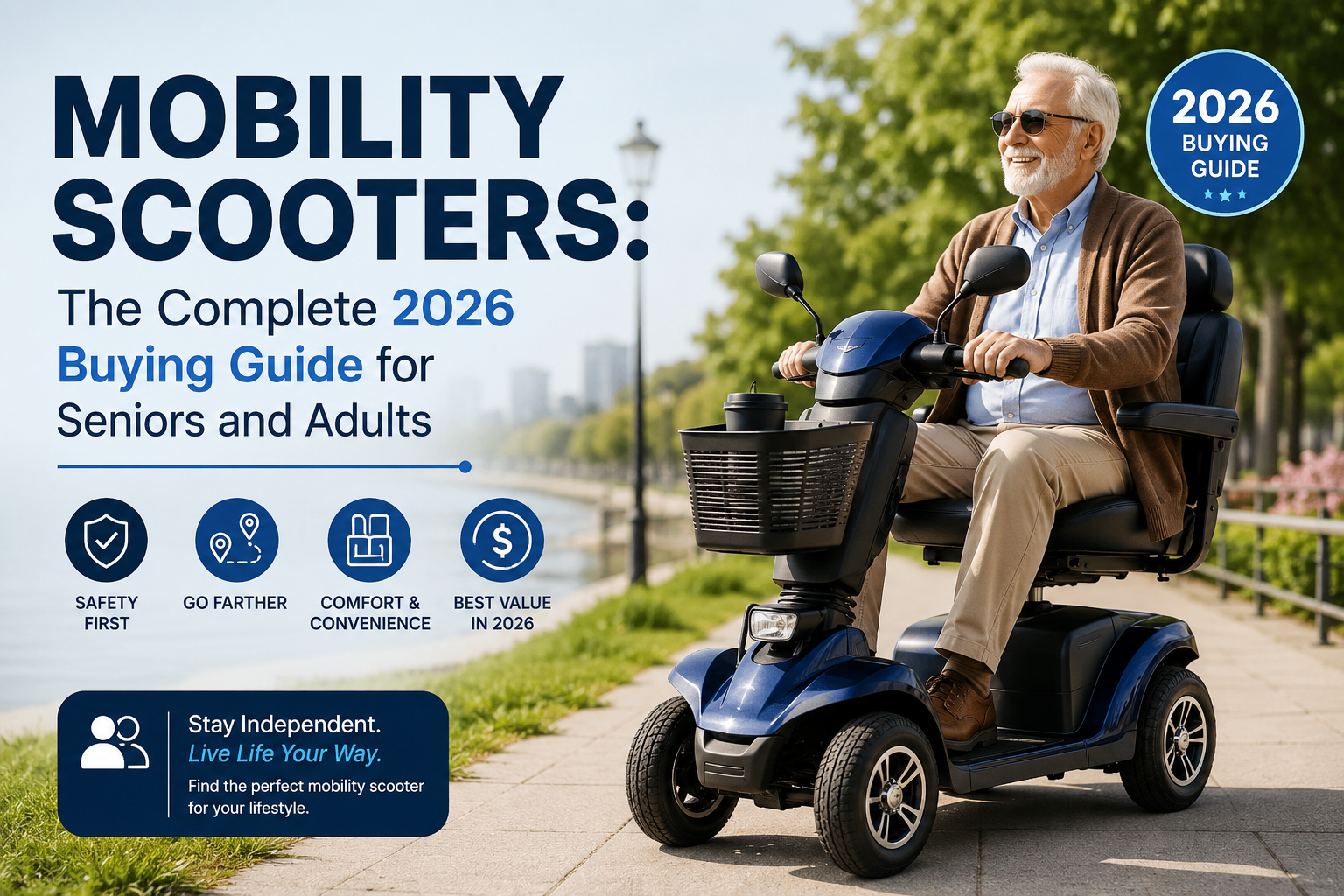
A mobility scooter is a battery-powered seated vehicle steered by a handlebar called a tiller. You sit in a raised swivel seat, rest your hands on the tiller, and drive with a thumb paddle or lever - press one way to go forward, the other way to reverse. It runs on rechargeable batteries, travels somewhere between 4 and 10 miles an hour depending on the model, and covers anywhere from about 8 to more than 25 miles on a charge.
The crucial thing to understand up front is how a scooter differs from the two devices people most often confuse it with:
- Versus a manual wheelchair: a wheelchair is pushed or self-propelled by the arms; a scooter is motorized and steered. Scooters are for people who can sit upright and use their hands but lack the stamina or leg strength to walk distances - not for people who need full postural support.
- Versus a power wheelchair: a power wheelchair is driven by a small joystick, turns almost in place, and is built for all-day indoor and outdoor use by people with significant disability. A scooter needs more room to turn, is easier for an occasional user to operate, and is generally better outdoors than in tight indoor spaces. More on this important distinction below.
You can see the range of styles, sizes, and weight capacities in the mobility products collection and the broader mobility aids collection at AllCare Store.
Is a Scooter the Right Device for You?
A mobility scooter is the right tool when a specific set of things are all true at once. You benefit most if you can:
- Sit upright unsupported for the length of a typical outing. A scooter seat has a backrest but no lateral trunk support.
- Walk short distances - to and from the scooter, around your kitchen, to the bathroom - but not the longer distances that used to be routine.
- Use both hands to steer the tiller and operate the throttle and controls.
- See well enough to spot curbs, people, and obstacles, and think clearly enough to judge speed and traffic.
This describes an enormous group of people: those with COPD, heart failure, or other conditions that limit stamina; severe arthritis or a bad hip or knee where walking distance is the problem; obesity-related mobility limits; post-stroke or neurological conditions with enough recovery to sit and steer safely; and simply advanced age with declining endurance, where the world has shrunk to the size of the house.
Who Should Look at Something Else
This section matters as much as the sales copy usually admits. A scooter is the wrong first choice - or the wrong choice entirely - when:
- You cannot sit up without support. If you slump, list to one side, or need a headrest and lateral supports, a properly configured power wheelchair is safer. See our power wheelchair and insurance guide.
- You need mobility mainly inside a small home. Scooters have a wide turning radius. In a compact house or apartment, a power wheelchair - or even a good rollator - will serve you far better indoors.
- Your hands or cognition cannot reliably run the controls. Significant tremor, hand weakness, or confusion make a tiller unsafe.
- The real problem is balance over short distances, not endurance over long ones. That is a job for a rollator or a cane, not a scooter.
- You would use it to avoid all walking. If you can still walk safely, keep doing it. Using the scooter only for the distances you genuinely cannot manage preserves the strength you have.
If you are not sure which side of these lines you fall on, that is exactly the conversation to have with an occupational therapist - and with our team by phone before you buy.
Scooter or Power Wheelchair? The Comparison That Decides Everything
This is the single most important decision, and getting it wrong is expensive. The two devices look like they solve the same problem, but they suit opposite situations.
| Consideration | Mobility Scooter | Power Wheelchair |
|---|---|---|
| Best environment | Outdoors, stores, open indoor spaces | Tight indoor spaces and all-day use |
| Steering | Two-handed tiller | One-hand joystick |
| Turning radius | Wide - needs room to maneuver | Tight - turns nearly in place |
| Postural support | Basic seat and backrest | Configurable, high support possible |
| User needs to | Sit up, use both hands, transfer on and off | Only operate a joystick |
| Typical user | Limited stamina, wants community range | Significant, often full-time disability |
The quick test: if your problem is distance and endurance and you can still sit up and steer, a scooter is usually the better and more affordable fit. If your problem is significant, all-day disability that includes indoor mobility and posture, look at power chairs like the Alante Sport Power Chair (about $2,165) or the LiteRider PTC Power Wheelchair (about $3,006) instead. Our guides to choosing the right wheelchair and wheelchairs for seniors go deeper on the wheelchair side.
Three Wheels or Four? The First Real Scooter Decision
Once you have decided a scooter is right, the first fork in the road is the number of wheels. Both are common, both are good, and they trade the same two things against each other: maneuverability versus stability.
Three-Wheel Scooters
A single front wheel gives a three-wheel scooter a tighter turning radius and more legroom. This makes it the better choice indoors and in tight spaces - narrower store aisles, restaurants, around furniture at home. The trade-off is slightly less stability on uneven ground and on side slopes, so they are best on smooth, level surfaces.
The Companion 3-Wheel Electric Scooter in mid-size (about $2,834) is a representative full-featured example, and the larger Companion II 3-Wheel Scooter in full-size (about $3,015) offers the same maneuverability with more range and a larger frame.
Best for: indoor use, tight spaces, and people who want maximum legroom and the tightest turns.
Watch out for: a bit less stability on rough or sloped terrain.
Four-Wheel Scooters
Two front wheels make a four-wheel scooter more stable - better on outdoor terrain, ramps, curbs, grass, gravel, and slopes. The cost is a wider turning radius, which makes them harder to use in tight indoor spaces. Four-wheel models also tend to carry larger batteries and higher weight capacities.
The Avenger GA541 4-Wheel Heavy Duty Scooter (about $5,259) sits at the rugged, high-capacity end of this category - built for longer distances, heavier users, and less forgiving ground.
Best for: outdoor and community use, uneven ground, longer trips, and heavier users.
Watch out for: a wider turning circle that struggles indoors, and a larger, heavier frame.
Three vs Four Wheels at a Glance
| Feature | Three-Wheel | Four-Wheel |
|---|---|---|
| Turning radius | Tighter | Wider |
| Stability | Good on level ground | Best on slopes and rough terrain |
| Legroom | More | Less |
| Best environment | Indoors and tight spaces | Outdoors and community |
| Typical weight capacity | 250-350 lbs | 300-500+ lbs |
Travel, Mid-Size, or Full-Size? Matching the Scooter to the Trip
The second sizing decision is the class of scooter, which is really a decision about how far you go and how you transport it.
Travel and Portable Scooters
These disassemble into a few lightweight pieces - typically the heaviest single piece is 30 to 40 pounds - so they fit in a car trunk without a lift. Range is usually shorter (roughly 8 to 12 miles), speed lower, and weight capacity modest. They are built for the person who is mostly out and about with a caregiver or spouse who can load the pieces.
Best for: occasional outings, travel, shopping trips, and anyone who must load the scooter into a car.
Watch out for: shorter range, lower capacity, and a less cushioned ride.
Mid-Size Scooters
The most popular category and the best all-around value for most buyers. Mid-size scooters balance range (often 12 to 18 miles), comfort, and capacity, and many can still be disassembled or loaded onto a vehicle lift. The Companion 3-Wheel mid-size scooter is a good example of this sweet spot.
Best for: daily use, most seniors, a mix of indoor and outdoor travel.
Watch out for: heavier than a travel model - plan how you will transport it.
Full-Size and Heavy-Duty Scooters
Built for range, comfort, terrain, and higher weight capacities (often 400 to 500 pounds or more). They have larger batteries, full suspension on many models, bigger tires, and captain's seats. They do not disassemble for a trunk - they need a vehicle lift or ramp. The Avenger GA541 4-Wheel Heavy Duty Scooter and the Companion II full-size scooter live here.
Best for: long distances, all-day use, heavier users, and rougher terrain.
Watch out for: size, weight, storage footprint, and the need for a lift or ramp to transport.
Reading the Specs That Actually Matter
Scooter product pages list a lot of numbers. Five of them decide whether the scooter fits your life. Learn these and you can compare any two models honestly.
1. Weight Capacity
Match the scooter to the user's weight with real margin - do not buy one you are sitting at the limit of. An overloaded scooter is slow, drains its battery fast, struggles on inclines, and wears out early. If the user is above about 300 pounds, look specifically at heavy-duty or bariatric models rated 400 to 500 pounds.
2. Range Per Charge
Range is how far the scooter goes on a full charge - and the advertised figure is a best case, measured with a light rider on flat ground at a steady speed. In the real world of hills, heavier riders, cold weather, and stop-and-go travel, plan on roughly 60 to 70 percent of the stated number. Add up your typical round trip and choose a range comfortably above it.
3. Ground Clearance and Tire Type
Ground clearance is the gap between the scooter's underside and the ground - it determines whether you can clear curbs, thresholds, and uneven pavement. Larger pneumatic (air-filled) tires ride more smoothly outdoors; solid tires never go flat but transmit more bumps. Outdoor users should favor higher clearance and larger tires.
4. Turning Radius
The turning radius tells you the tightest circle the scooter can make. Measure the doorways, hallways, and the store or restaurant you most want to use, and compare. This single number is why so many people who bought a big four-wheel scooter for outdoors end up leaving it parked at the door indoors.
5. Total Weight and Heaviest Piece
If you will transport the scooter, the number that matters is not total weight but the weight of the heaviest single piece once disassembled, or the total weight if it will ride on a lift. A 34-pound heaviest piece is manageable for many caregivers; a 90-pound base is not something you lift into a trunk.
Does Medicare Cover Mobility Scooters? The Honest Answer
Sometimes - and the rules are stricter and more specific than most advertising suggests.
Medicare Part B covers mobility scooters as durable medical equipment, in the category it calls power-operated vehicles, or POVs. These are billed under a family of HCPCS codes beginning around K0800 (through roughly K0812 for the different POV groups). When a claim is approved, Medicare pays 80 percent of its approved amount after you have met your annual Part B deductible, and you pay the remaining 20 percent. You must buy from a Medicare-enrolled DME supplier that accepts assignment.
The Coverage Criteria
To approve a scooter, Medicare generally needs the documentation to establish all of the following:
- You have a medical condition that significantly impairs your mobility at home.
- You cannot perform daily activities - moving between rooms, reaching the bathroom or kitchen - even with a cane, walker, or manual wheelchair.
- You can safely operate the scooter: you can sit up on your own, transfer on and off, and steer and control it with adequate hand function, vision, and judgment.
- The scooter is needed to function within the home, and your home can accommodate it (doorways, turning space, surfaces).
- A face-to-face examination with your physician has taken place and a written order has been issued.
Read that fourth point carefully, because it is the one that surprises people: Medicare evaluates whether you need the device to get around inside your home, not primarily for outdoor or community use. A scooter that is wonderful at the store but cannot turn in your hallway can actually be harder to get covered - which is one more reason to size for your real home before you shop.
What You Will Need
- A face-to-face physician evaluation documenting your mobility limitation and why lesser aids will not work.
- A written order from the physician for the POV, dated appropriately.
- Purchase from a Medicare-enrolled supplier that accepts assignment.
- Signed proof of delivery, and often a home assessment.
Other Coverage Routes
Medicare Advantage plans sometimes offer different or better mobility benefits than Original Medicare - check your plan's DME schedule. Medicaid coverage varies significantly by state. The VA covers scooters for eligible veterans through its own, often more generous, process. And a mobility scooter is typically an eligible HSA or FSA expense with a letter of medical necessity, which for many buyers is the simplest path to a meaningful discount. Whatever route you take: get the physician's order first, keep every receipt, and call your plan before you buy rather than after.
What Mobility Scooters Cost in 2026
| Type | Typical 2026 Price | Makes Sense When |
|---|---|---|
| Travel / portable scooter | $900-$1,800 | Occasional outings; must fit in a car trunk |
| Mid-size scooter | $1,800-$3,200 | Most buyers - best all-around value |
| Full-size / heavy-duty scooter | $3,200-$5,500+ | Long range, all-day use, heavier users, rough terrain |
| Replacement battery pack | $150-$450 | Every 1-2 years as batteries age |
| Portable / threshold ramp | $145-$1,100 | Steps, thresholds, or vehicle loading |
Prices shown are typical 2026 market ranges; specific product prices quoted in this article were current at the time of writing and may change. Batteries are the recurring cost that surprises new owners - a long-life pack such as the 90-hour long-charge battery for power chairs and scooters (about $425) is worth budgeting for every year or two.
Getting It There: Transport and Ramps
The question that undoes more scooter purchases than any other is not can I drive it, but how do I move it. Answer that before you buy, not after.
- Trunk transport. Only travel and some mid-size scooters disassemble small enough to lift into a trunk. Check the weight of the heaviest single piece against what your helper can actually lift - repeatedly, in a parking lot, in bad weather.
- Ramps. For loading into an SUV or van, or getting up a few steps at home, a portable ramp is the simplest solution. The aluminum modular threshold ramp (from about $145) handles doorways and small rises, while folding ramps such as the EZ-ACCESS Suitcase Signature Series ramp (from about $255) and the longer Suitcase Trifold ramp (from about $698) bridge vehicles and steps. Browse the full wheelchair ramps collection to match length to the rise you need to climb - the gentler the slope, the safer the load.
- Vehicle lifts. Full-size scooters that do not disassemble need an exterior hitch lift or an interior platform lift. These are a separate purchase and installation - factor them into the budget from the start.
- Storage and charging at home. Plan a flat, dry spot near a grounded outlet where the scooter lives and charges. Do not park it where the cord crosses a walkway.
Accessories Worth Considering
- A comfortable, pressure-relieving seat cushion if you will sit for long stretches. The seat cushions collection covers gel, foam, and air options that reduce pressure and improve comfort.
- A spare or long-life battery, like the 90-hour long-charge battery, so range never strands you.
- Mounting hardware and holders. A scooter accessory mounting bracket (about $80) gives you a solid point to attach baskets, cane holders, and accessories.
- Weather protection. A canopy or a simple rain poncho keeps you dry on the way home when the sky turns.
- Lights and a flag or reflectors for visibility, especially if you cross parking lots or ride near dusk.
- A cane or crutch holder so your walking aid travels with you and stays within reach for the short distances you still walk.
You will find baskets, batteries, brackets, tires, and replacement parts in the mobility accessories and parts collection.
Using a Mobility Scooter Safely
- Learn it slowly. Practice starting, stopping, and turning at the lowest speed setting in an open space before you take it into traffic or a crowded store. The throttle is more sensitive than people expect.
- Set your speed to the setting, not just the throttle. Keep the speed dial low indoors and in crowds; save the higher settings for open outdoor paths.
- Take curbs and slopes straight on, never at an angle, and use curb cuts wherever possible. Angling across a slope is the classic way a scooter tips.
- Do not exceed the weight capacity, including any items you carry in baskets.
- Charge it regularly and watch the gauge. Running a battery flat repeatedly shortens its life, and being stranded far from home is both dangerous and frightening.
- Stay visible. Use lights and reflectors, make eye contact with drivers in parking lots, and assume you have not been seen.
- Transfer carefully. Lock the scooter, swivel the seat, and use the armrests. Keep your footwear non-slip and, if balance is an issue, have a grab point planned.
- Know the local rules. Scooters generally belong on sidewalks and in buildings, not in the road; follow pedestrian rules and yield to people on foot.
Living With a Scooter: What Nobody Tells You
The first week is emotional, not mechanical. For many people the hardest part of a scooter is not learning to drive it - it is being seen on it. The device is a public statement about mobility in a way a cane is not. Most people find that within a few weeks the independence completely outweighs the self-consciousness, but it is real at the start, and worth naming. Our piece on setting up a home and a life around mobility aids speaks to this directly.
It can quietly reduce your walking - guard against that. A scooter is so convenient that it is tempting to ride distances you could still safely walk. Keep walking the distances you can manage; use the scooter for the ones you cannot. The strength you preserve is the strength that keeps you transferring safely.
Range anxiety is real, and manageable. New owners often overestimate how far they will go and underestimate how hills and cold cut into the battery. Plan trips with margin for the first month until you learn your true range.
Indoors is where reality bites. People fall in love with a big outdoor scooter and then discover it cannot turn in their kitchen. If you need indoor mobility too, measure first - or accept that the scooter is an outdoor tool and keep a rollator or power chair for inside.
Sitting all day brings its own risks. Prolonged sitting promotes pressure on the skin and swelling in the legs. Shift your weight, stand when you safely can, and consider a pressure-relieving cushion. If swelling is part of your picture, talk to your doctor about elevation and compression.
Maintenance: A Few Minutes That Save a Breakdown
- Charge after use, not just when empty. Sealed scooter batteries last longest when topped up regularly rather than run flat.
- Check tire pressure on pneumatic tires; low pressure kills range and handling.
- Inspect the tiller controls and throttle for smooth, predictable response before each outing.
- Keep it dry. Wipe down after wet trips and store indoors; electronics and moisture do not mix.
- Replace batteries proactively. When range drops noticeably, the pack is aging - swap it before it strands you rather than after.
- Listen for changes. New noises, a pull to one side, or slower acceleration are early warnings. Call for service then, not after a failure.
Why Shop Mobility Scooters and Power Mobility at AllCare Store
AllCare Store carries three- and four-wheel mobility scooters, travel and heavy-duty models, power wheelchairs, batteries, ramps, cushions, and the replacement parts and accessories that keep them all running. Everything ships free within the U.S. with 30-day returns.
Scooters are one of the categories where a phone call genuinely beats a search bar. Weight capacity is not negotiable, turning radius has to match your actual home, transport has to match your actual vehicle, and the choice between a scooter and a power wheelchair depends on details of your condition that a product page cannot ask about. Our team walks people through this every day.
Start with the mobility products collection, the mobility aids collection, the wheelchair ramps collection, or the mobility accessories and parts collection.
Frequently Asked Questions
Does Medicare pay for a mobility scooter?
It can. Medicare Part B covers mobility scooters as power-operated vehicles (POVs) under HCPCS codes in the K0800 family when they are medically necessary for use in your home. After your Part B deductible, Medicare pays 80 percent of its approved amount and you pay 20 percent, and you must buy from a Medicare-enrolled supplier that accepts assignment. You will need a face-to-face physician exam and a written order first.
What conditions qualify for a covered scooter?
Generally a condition that significantly limits your mobility at home, where a cane, walker, or manual wheelchair is not enough, and where you can still sit up, transfer, and safely operate the scooter. The key test is whether you need it to move around inside your home, not only outdoors.
What is the difference between a mobility scooter and a power wheelchair?
A scooter is steered with a two-handed tiller, needs room to turn, and suits people with limited stamina who can sit up and use their hands - it shines outdoors and in open spaces. A power wheelchair is driven with a one-hand joystick, turns almost in place, offers more postural support, and suits people with more significant, often all-day disability, including indoor mobility.
Should I get a three-wheel or four-wheel scooter?
Choose three wheels for tighter turns, more legroom, and indoor use on level ground. Choose four wheels for stability outdoors, on slopes, and on rough terrain, and for higher weight capacities. If you mostly go to stores and restaurants, three wheels; if you cover distance outdoors, four.
How far can a mobility scooter go on one charge?
Depending on the model, roughly 8 to 25-plus miles. Treat the advertised range as a best case and plan on about 60 to 70 percent of it in real conditions, because hills, heavier riders, cold weather, and stop-and-go travel all reduce range.
Can I take a mobility scooter apart to put it in a car?
Travel and some mid-size scooters disassemble into a few pieces for trunk transport - check the weight of the heaviest single piece against what your helper can lift. Full-size and heavy-duty scooters do not; they need a vehicle lift or a ramp.
How much does a good mobility scooter cost in 2026?
Travel models run roughly $900 to $1,800, mid-size scooters about $1,800 to $3,200, and full-size or heavy-duty models from about $3,200 to $5,500 or more. Budget separately for batteries every year or two and, if needed, ramps or a vehicle lift.
What weight can a mobility scooter hold?
Standard scooters typically support 250 to 350 pounds; heavy-duty and bariatric models support 400 to 500 pounds or more. Always choose a capacity with margin above the user's weight, including anything carried, so the motor and battery are not working at their limit.
Are mobility scooters safe for someone with dementia?
It depends entirely on whether the person can judge speed, spot hazards, and operate the controls reliably. Significant cognitive impairment usually makes a scooter unsafe. Get an occupational therapy assessment before deciding, and consider caregiver-operated options instead.
Can I ride a mobility scooter on the road or sidewalk?
Scooters are generally meant for sidewalks, paths, and buildings, following pedestrian rules and yielding to people on foot - not for travel in the road. Local rules vary, so check your municipality, and always prioritize visibility with lights and reflectors.
How long do mobility scooter batteries last?
The batteries themselves typically last one to two years before range drops enough to warrant replacement, depending on how you charge and use them. Charging regularly rather than running the pack flat, and storing the scooter indoors, both extend battery life.
Do I need a ramp for my scooter?
You do if there are steps or a raised threshold between the scooter and where you need to go, or if you load it into an SUV or van. Match the ramp length to the height you must climb - longer ramps make a gentler, safer slope. See the wheelchair ramps collection for threshold, folding, and handrail options.
The Takeaway: A Scooter Gives Back Distance
A mobility scooter does not treat your hip, your lungs, or your heart. What it restores is range - the ordinary hundred-yard distances that add up to a trip to the store, an afternoon at the fair, a walk with the grandchildren that you finish instead of abandon.
Buy it for the right reason: distance and stamina, not balance or posture. Decide honestly between a scooter and a power wheelchair. Match the wheels, the size, and the turning radius to your real home and your real vehicle before you fall for a model. Get the physician's order before you order the scooter. And keep walking the distances you safely can.
Done well, it is not a machine that announces your limits. It is the reason the world stops shrinking.
Not Sure Which Scooter Fits Your Life? Let's Talk It Through.
AllCare Store stocks three- and four-wheel mobility scooters, travel and heavy-duty models, power wheelchairs, batteries, ramps, cushions, and the accessories and replacement parts that go with them. Browse the mobility products collection, the mobility aids collection, and the wheelchair ramps collection to compare options.
Call 1-888-889-6260 to speak with a specialist about weight capacity, turning radius, transport, and Medicare documentation, or visit AllCareStore.com to browse the full product line. Free U.S. shipping and 30-day returns on every order.
This guide was written and reviewed by the AllCare Store editorial team. Coverage rules, fee schedules, and product pricing change - verify current details with your insurer and your supplier. For personalized medical advice, consult your physician or a licensed occupational or physical therapist.
MEDICAL DISCLAIMER: This article is for informational purposes only and is not a substitute for professional medical advice, a physician's evaluation, or an occupational or physical therapy assessment. Whether a mobility scooter is appropriate and safe for you depends on your diagnosis, your strength, balance, vision, hand function, and cognition, as well as your home and community environment. A scooter requires you to sit upright without support, steer with your hands, and operate controls safely. Always follow the guidance of your physician or licensed therapist, and ask them to confirm that a scooter is the right device for you before you rely on one. Insurance and Medicare coverage rules change and vary by plan and region - verify current coverage with your plan and your supplier before you buy. If you experience new dizziness, chest pain, sudden weakness, a fall, or a change in your ability to sit upright or control the scooter, stop using it and seek medical attention.