The Trunk of the Car, and the Question Nobody Asked First
Robert is 74, two years past a stroke that left his left side weaker than his right. He walks well enough around the house with a cane, and for a while the family told themselves that was the whole story. Then his granddaughter's wedding came up — an outdoor venue, a long gravel path from the parking lot, a reception a football field away from the ceremony. His daughter Anne bought a wheelchair online the week before, the cheapest one she could find that shipped in time.
It weighed almost fifty pounds. The seat was too narrow. It would not fit in her trunk without folding down the back seats, and once it was in there, she couldn't lift it out alone. On the gravel path the small front wheels dug in and stopped dead. Robert spent most of the wedding parked in one spot because moving him was a two-person job that exhausted everyone involved. The chair did its literal job — he had somewhere to sit — and failed at the actual job, which was letting him move through his granddaughter's wedding like a participant instead of a fixture.
The question Anne wished someone had asked her first was not "which wheelchair is cheapest" or even "which is best." It was: who is going to push it, where, and how does it get into the car? Those three answers — the user's own strength, the terrain, and transport — decide which of the four main wheelchair types is right far more than the price tag does. Get them right and the chair disappears into the background of a good day. Get them wrong and it becomes the day.
This guide is built around those questions. Let's start with what the four types actually are.
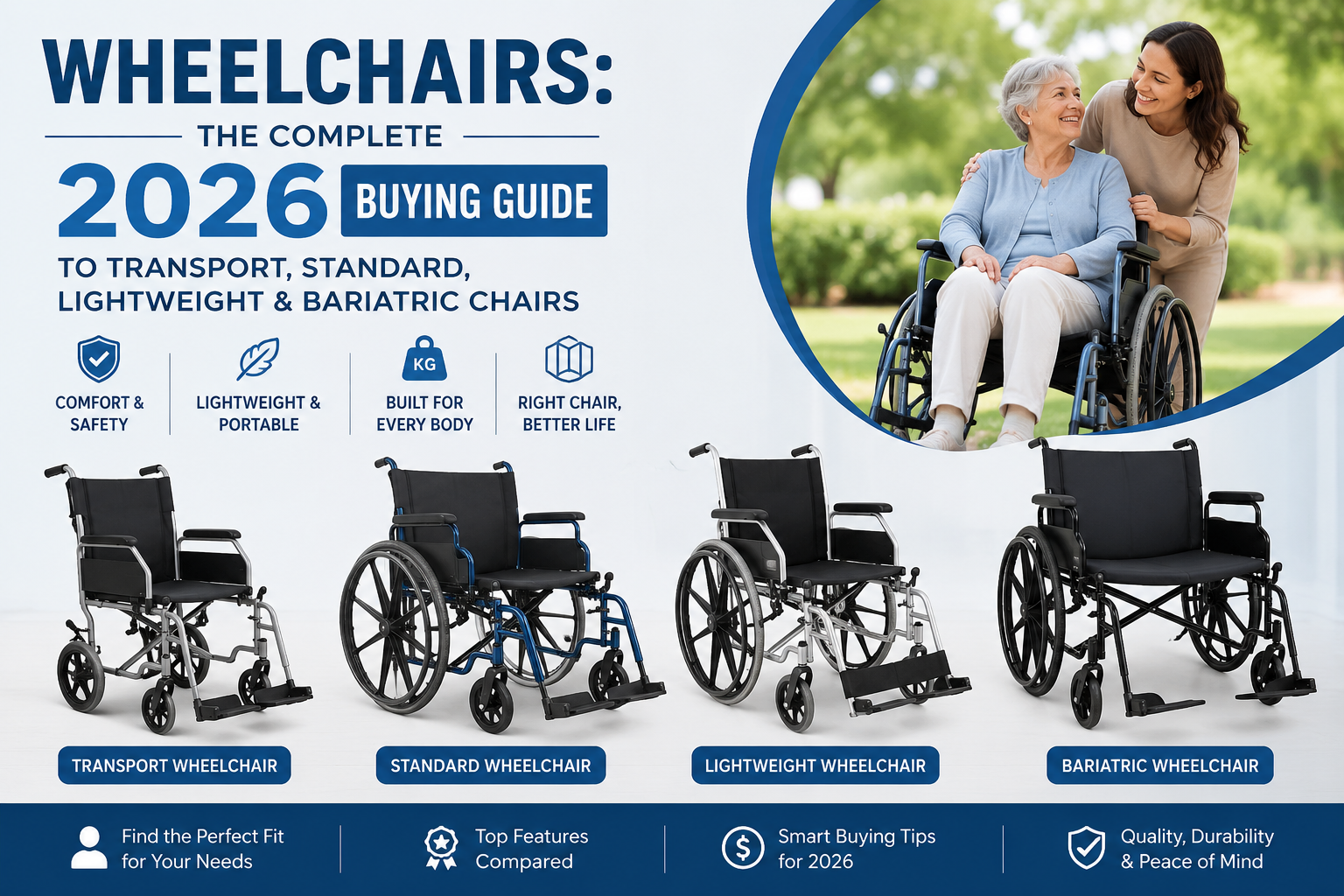
The Four Types of Manual Wheelchairs
Nearly every manual (non-powered) wheelchair falls into one of four families. The single most important distinction is the back wheel: large rear wheels mean the user can self-propel; small rear wheels mean someone else pushes. That one detail separates a standard wheelchair from a transport chair and shapes everything else.
1. Transport Chairs (Companion-Propelled)
All four wheels are small, so the person sitting cannot roll themselves — a companion pushes from behind. In exchange you get a chair that is lighter, narrower, and easier to fold and lift into a car. This is the right tool for Robert's wedding: occasional outings, airports, doctor's visits, and anywhere the user has help and doesn't need to move independently.
The Drive Medical Lightweight Transport Wheelchair (about $223) is the classic version — padded armrests, swing-away footrests, and a folding frame that slides into most trunks. For travelers who want the lightest possible option, the Drive Medical Fly-Lite Transport Chair (about $280) strips weight further with a carry pocket on the backrest.
Best for: people who have a caregiver, want maximum portability, and travel.
Watch out for: the user cannot move independently, and small wheels handle bumps, thresholds, and rough ground poorly.
2. Standard Wheelchairs (Self-Propelled)
Large rear wheels — usually 24 inches — with hand rims the user grips to roll themselves. These are the everyday workhorses: durable steel frames, seat widths from 16 to 20 inches, and weight capacities around 300 pounds. They are heavier than transport chairs (often 35 to 45 pounds) and take up more room in a car, but they buy the user independence.
A representative example is the Drive Medical Standard Wheelchair with fixed arms and swing-away footrests (about $363). On a tighter budget, the Drive Medical 18-inch wheelchair with fixed full arms (about $189) covers the essentials.
Best for: daily users who can push themselves and want independence indoors and out.
Watch out for: weight and folded size make frequent car transport a chore.
3. Lightweight & Ultra-Lightweight Wheelchairs
Same self-propelling design as a standard chair, but built from aluminum to shave pounds — and often with flip-back or removable arms and quick-release wheels that make transfers and car loading dramatically easier. A lighter chair is also less tiring to push all day, which matters as much for the person's arms as for the caregiver's back.
The Drive Medical Viper Wheelchair (about $706) is a deluxe lightweight example with flip-back desk arms that let the user slide sideways into a bed or car seat without the armrest in the way.
Best for: active daily users, anyone who transfers often, and households that load the chair into a car regularly.
Watch out for: price climbs with every pound you save.
4. Bariatric (Heavy-Duty) Wheelchairs
Reinforced frames and wider seats built for users above roughly 300 pounds, with capacities commonly running from 400 to 600 pounds and seat widths of 22 to 30 inches. Choosing a bariatric chair is not optional for heavier users — a standard frame loaded past its rating bends, rolls harder, and becomes unsafe.
The Drive Medical Bariatric Wheelchair (about $632) offers a 22-inch seat and support up to 450 pounds with removable desk-length arms and swing-away footrests. For a broader look at heavy-duty mobility, our bariatric walker buying guide covers the same principles for walking aids.
Best for: users whose weight exceeds a standard chair's rating, or who need a wider seat for comfort.
Watch out for: confirm doorway and hallway clearance — wider seats mean a wider overall chair.
Comparison at a Glance
| Feature | Transport Chair | Standard | Lightweight | Bariatric |
|---|---|---|---|---|
| Rear wheels | Small | Large (~24 in.) | Large (~24 in.) | Large or small |
| Self-propel? | No | Yes | Yes | Depends on model |
| Typical weight | 15–30 lbs | 35–45 lbs | 25–34 lbs | 45–70 lbs |
| Weight capacity | 250–300 lbs | 300 lbs | 300 lbs | 400–600 lbs |
| Best terrain | Smooth indoor | Indoor + paved | Indoor + paved | Indoor + paved |
| Typical 2026 price | $220–$300 | $190–$400 | $400–$900 | $600–$1,500 |
You can compare current models, seat widths, and prices across all four categories in the wheelchairs and accessories collection and the wider mobility products collection.
Transport Chair vs. Standard Wheelchair: The Decision That Trips Everyone Up
This is the choice families get wrong most often, usually by buying a transport chair because it's cheaper and lighter — and then discovering the user wanted to move around on their own.
Ask one question: will the person move themselves, even part of the time? If yes, they need the large rear wheels of a standard or lightweight chair. If they will always be pushed by someone else, a transport chair is lighter, narrower, and easier to live with. Many households eventually own both — a standard chair for daily independence at home and a folding transport chair that lives in the trunk for outings. If independence is the goal but walking is still partly possible, also read our walkers vs. rollators guide, because a rollator with a seat may be the better everyday answer.
Sizing: The Part That Actually Prevents Injuries
A wheelchair that doesn't fit isn't just uncomfortable — over weeks it causes pressure sores, poor posture, and shoulder strain. Two measurements matter most: seat width and seat-to-floor height. Take them with the user seated, wearing normal clothing, ideally in the afternoon when any swelling is at its typical level.
Seat Width
Measure across the widest part of the hips or thighs while seated, then add about one to two inches total (roughly a half-inch to an inch of space on each side). You should be able to slide a flat hand down each side between hip and armrest. Too narrow presses on the hips and thighs and risks skin breakdown; too wide removes the side support the user leans on and makes self-propelling harder because the hand rims sit too far apart.
| Hip Width (seated) | Recommended Seat Width |
|---|---|
| Up to 15 in. | 16 in. (narrow adult) |
| 15–17 in. | 18 in. (standard adult) |
| 17–19 in. | 20 in. |
| 19 in. and up | 22–30 in. (bariatric) |
Seat-to-Floor Height and Seat Depth
With the user's feet on the footrests, thighs should rest lightly on the seat with knees at roughly 90 degrees — not knees riding high (seat too low) or feet dangling (seat too high). For self-propellers who also "foot-walk" the chair by pushing with their heels, a lower seat lets the feet reach the floor. For seat depth, aim for a two-to-three-finger gap between the front edge of the seat and the back of the knee.
Armrests and Footrests
Desk-length arms slide under a table; full-length arms give more forearm support. Flip-back or removable arms make side transfers to a bed or car far easier — a feature worth paying for if the user transfers often. Swing-away, elevating footrests get out of the way for standing transfers and let you elevate a leg after surgery or with swelling.
Does Medicare Cover a Wheelchair? The Honest Answer
Often, yes — manual wheelchairs are covered under Medicare Part B durable medical equipment when they're medically necessary for use inside the home, but the rules are specific and the paperwork is everything.
- A standard manual wheelchair is billed under HCPCS code K0001. Lightweight and other categories have their own codes (K0002 and up).
- You'll need a face-to-face visit and a written order from your physician documenting why you need the chair to move around within your home — Medicare's test is mobility inside the house, not just for outings.
- Purchase from a Medicare-enrolled DME supplier that accepts assignment. After your Part B deductible, Medicare pays 80% of the approved amount and you pay the remaining 20%.
- Importantly, Medicare generally covers either a standard or a transport chair, not both, and a transport chair alone may not satisfy the "mobility within the home" requirement if the user could self-propel a standard chair.
Medicare Advantage plans, Medicaid (varies by state), and the VA all have their own — sometimes more generous — pathways. A wheelchair is also typically an eligible HSA or FSA expense. Whatever the route: get the physician's order first, buy from an enrolled supplier, and keep every receipt. Rules and fee schedules change, so confirm current details with your plan before you purchase.
What Wheelchairs Cost in 2026
| Type | Typical Cost | Makes Sense When |
|---|---|---|
| Budget standard | $180–$250 | Occasional home use, tight budget |
| Transport chair | $220–$300 | Outings with a caregiver; travel |
| Standard self-propel | $300–$400 | Daily independent use at home |
| Lightweight / ultra-light | $400–$900 | Frequent transfers and car loading |
| Bariatric | $600–$1,500 | User weight above ~300 lbs |
| Rental | $40–$100/week | Short recovery of a few weeks |
Prices shown are typical 2026 market ranges; specific product prices quoted in this article were current at the time of writing and may change. As with most recovery equipment, the rent-versus-buy line falls around two months: shorter, rent; longer, buy.
Accessories That Actually Matter
- A pressure-relief seat cushion. The most important accessory, and the one most often skipped. Anyone sitting for more than an hour or two at a time needs one to prevent pressure injuries and improve comfort. A gel cushion like the ObusForme Gel Seat (about $59) is a sensible starting point; heavier users and full-time sitters should ask about foam-and-gel or air cushions.
- A threshold ramp. Doorway lips and raised entries stop small front wheels cold. An aluminum threshold ramp (from about $145) makes those transitions effortless for both wheelchairs and scooters.
- Anti-tip bars, a cup holder, and a cane or oxygen holder for everyday practicality.
- A seatbelt or positioning belt where the care team recommends one for safety.
- A pressure-relief plan for the skin, not just a cushion — shift weight and reposition regularly, especially for full-time users.
Browse cushions, ramps, and replacement parts in the wheelchairs and accessories collection.
Home, Transport, and Everyday Use
- Measure your narrowest doorway and tightest turn. Overall chair width runs about 8 inches wider than the seat width. A 20-inch seat is roughly a 28-inch chair — snug for a 30-inch door.
- Plan how it gets into the car. This is the deciding factor for many families. Fold the chair, weigh it, and make sure the person doing the lifting can manage it. Quick-release wheels and flip-back arms make a real difference.
- Set the brakes every single time before anyone sits down or stands up. Most wheelchair falls happen during transfers with the brakes off.
- Never push a transport chair up a steep ramp facing forward if you can avoid it, and back down steep declines. For unavoidable rough ground, larger rear wheels help — another point for the standard chair.
- Match the chair to the person's other equipment. If they also use a walker at home, our standard walker guide and the mobility scooter buying guide help you build a setup that works together rather than in pieces.
- For safe seated transfers, a sliding board bridges the gap between chair and bed or car — see our transfer boards and slide boards guide.
Why Shop Wheelchairs at AllCare Store
AllCare Store carries transport chairs, standard and lightweight self-propelled wheelchairs, bariatric models, and the cushions, ramps, footrests, and replacement parts that keep them working. Everything ships free within the U.S. in discreet packaging, with 30-day returns.
Wheelchairs are a category where a two-minute phone call beats an hour of guessing. Seat width has to match the person, weight capacity is not negotiable, and the transport-versus-standard choice depends on details a product page can't ask about. Our team helps people get this right every day.
Start with the wheelchairs and accessories collection or the broader mobility products collection.
Frequently Asked Questions
What is the difference between a transport chair and a wheelchair?
A transport chair has four small wheels and must be pushed by a companion — the user cannot roll themselves. A standard wheelchair has large rear wheels with hand rims so the user can self-propel. Transport chairs are lighter and easier to travel with; standard chairs offer independence.
How do I know what seat width to buy?
Measure across the widest part of the hips or thighs while seated and add one to two inches total. Most adults land at an 18-inch seat. Too narrow risks pressure sores; too wide removes side support and makes self-propelling harder.
Does Medicare pay for a wheelchair?
Yes, when it's medically necessary for mobility inside your home. A standard manual chair is billed under code K0001 through a Medicare-enrolled supplier; after your Part B deductible Medicare pays 80% of the approved amount. You'll need a face-to-face visit and a written physician order. Medicare generally covers a standard or a transport chair, not both.
How much does a good wheelchair cost in 2026?
Budget standard chairs start around $180–$250, transport chairs run $220–$300, everyday self-propelled chairs $300–$400, lightweight models $400–$900, and bariatric chairs $600–$1,500. Prices were current at the time of writing and may change.
How much does a wheelchair weigh, and will it fit in my car?
Transport chairs are lightest at roughly 15–30 pounds, standard steel chairs 35–45 pounds, and lightweight aluminum chairs 25–34 pounds. All fold, but weight and folded size decide whether one person can load it. If frequent car transport matters, prioritize a lightweight chair with quick-release wheels and flip-back arms.
What weight capacity do I need?
Standard and lightweight chairs are rated to about 300 pounds. If the user is near or above that, choose a bariatric model rated 400–600 pounds — overloading a standard frame is unsafe and wears it out quickly.
Do I need a wheelchair cushion?
Almost always yes. Anyone sitting more than an hour or two at a time needs a pressure-relief cushion to prevent skin breakdown and improve comfort. Gel cushions are a common starting point; full-time users should ask about air or foam-and-gel options.
Can a wheelchair go over grass, gravel, or curbs?
Poorly, especially transport chairs with small wheels. Large rear wheels handle rough ground better, and a threshold ramp solves doorway lips. For genuinely rough outdoor use, an all-terrain mobility device is a better fit.
Should I rent or buy a wheelchair?
Rent for a short, defined recovery of a few weeks. Buy for any ongoing need — at typical rental rates, roughly two months of renting approaches the purchase price of a solid standard chair.
What is the difference between lightweight and standard wheelchairs?
Both self-propel; the difference is the frame. Lightweight chairs use aluminum to cut 10–15 pounds and often add flip-back arms and quick-release wheels, making transfers and car loading easier. They cost more. Standard steel chairs are heavier but more affordable and very durable.
The Takeaway: Match the Chair to the Person, the Terrain, and the Car
The best wheelchair isn't the cheapest or the fanciest — it's the one that fits the person's body, matches how they'll actually use it, and gets where it needs to go without wearing out the people around them. Decide first whether the user will move themselves, measure the seat width honestly, confirm the weight capacity, and think through the doorway and the trunk before you buy.
Get those four things right and, like Robert's family eventually learned, the chair stops being the story of the day and goes back to being what it should be: the quiet thing that let someone show up.
Not Sure Which Wheelchair Fits? Let's Talk It Through.
AllCare Store stocks transport chairs, standard and lightweight self-propelled wheelchairs, bariatric models, and the cushions, ramps, footrests, and parts that go with them. Browse the wheelchairs and accessories collection and the mobility products collection to compare seat widths, weights, and prices.
Call 1-888-889-6260 to speak with a specialist about sizing, weight capacity, and Medicare documentation, or visit AllCareStore.com to browse the full product line. Free U.S. shipping, discreet packaging, and 30-day returns on every order.
This guide was written and reviewed by the AllCare Store editorial team. Coverage rules, fee schedules, and product pricing change — verify current details with your insurer and your supplier. For personalized medical advice, consult your physician or a licensed physical or occupational therapist.
MEDICAL DISCLAIMER: This article is for informational purposes only and is not a substitute for professional medical advice, a physician's evaluation, or a physical or occupational therapy assessment. The right wheelchair depends on your diagnosis, your strength, your ability to self-propel, your skin condition, your body measurements, and your home layout. A chair that is the wrong width or seat height can cause pressure injuries, poor posture, and falls. Always have a clinician or certified assistive-technology professional confirm your fit and setup before you rely on a wheelchair full time. Insurance and Medicare coverage rules change and vary by plan and region — verify current coverage with your plan and supplier before purchasing. If a new wound, numbness, or sudden change in strength or breathing appears, seek medical attention promptly.