The Sock That Stopped Ted in His Tracks
Ted is 71, three days home from a right hip replacement, and he is sitting on the edge of his bed holding a single white sock, defeated. His surgery went beautifully. His pain is well controlled. His surgeon is delighted. And he cannot put on a sock.
The reason is not weakness. It is a rule. Ted was sent home with hip precautions: do not bend the hip past 90 degrees, do not cross the operated leg over the other, do not rotate the leg inward. Those three rules protect a new joint that has not yet grown the scar tissue it needs to stay in its socket. And those same three rules make it physically impossible to reach his own foot the way he has reached it every morning for seven decades.
So Ted has a choice. He can wait for his daughter to drive over twice a day to put his socks and shoes on for him, which makes a capable retired electrician feel like a child. He can skip the socks, which is not an option in a New England October. Or he can use a thirty-dollar plastic gutter with two cords attached to it, load the sock onto it, drop it to the floor, slide his foot in, and pull.
He chose the plastic gutter. It is called a sock aid, and by the end of the first week Ted was dressing himself completely, unassisted, in about the time it used to take. His daughter went back to visiting because she wanted to, not because he could not get his pants on.
That is the entire promise of this category of products. Dressing aids and reaching tools do not treat anything. They give back the small, private, daily acts — pulling on a sock, retrieving a dropped remote, buttoning a shirt — that turn out to be the difference between depending on someone and living on your own terms. They are among the least expensive and most quietly life-changing things AllCare Store sells.
What Dressing Aids and Reaching Tools Actually Are
These are simple, mostly non-powered devices that extend your reach or add leverage so you can dress and pick things up without bending, twisting, or gripping in ways that hurt, are unsafe, or are temporarily forbidden. Occupational therapists call them aids to daily living, and they are a standard part of recovery after joint surgery and a standard accommodation for arthritis, back pain, and limited mobility.
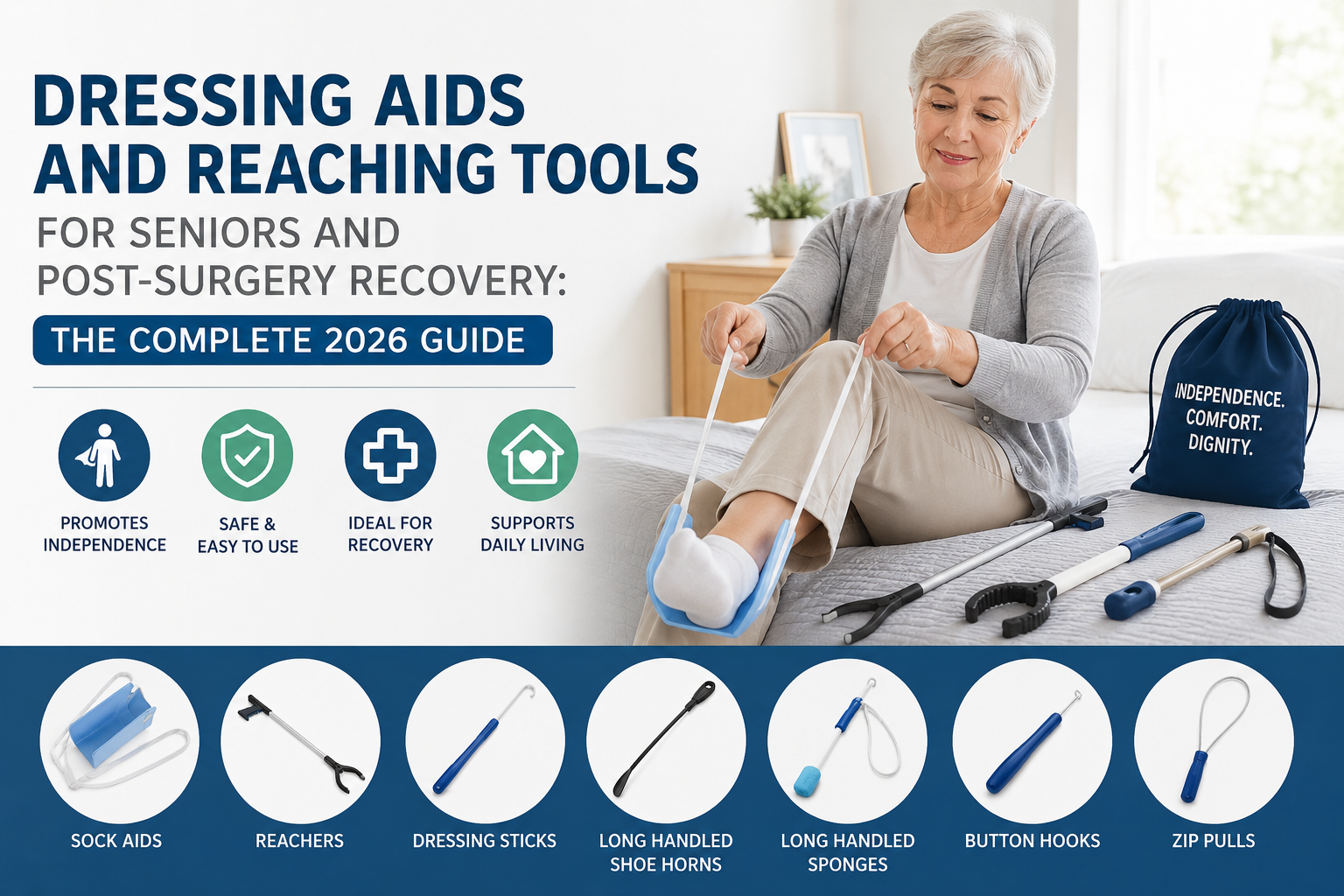
The core toolkit is small and you can see the full range in the AllCare Store Aids to Daily Living collection and Reachers and Grabber Tools collection. It usually includes:
- Reachers and grabbers — a long arm with a trigger-operated claw
- Dressing sticks — a rod with hooks to push and pull clothing
- Sock aids — a flexible shell that holds a sock open so you can slide your foot in
- Long-handled shoehorns — so you never bend to your heel
- Button hooks and zipper pulls — for hands with limited dexterity
- Leg lifters — a strap to lift a weak or heavy leg into bed or a car
- Donning aids — tools and gloves that make compression socks manageable
- Hip kits — a bundle of the above, sold together for surgery recovery
Who These Tools Are For
Dressing aids help whenever the barrier is reaching, bending, or gripping — not walking. That covers a very large group of people:
- Hip and knee replacement patients, especially in the first 6 to 12 weeks, where reaching aids are essentially required equipment (see our hip replacement recovery timeline and knee replacement recovery guide)
- People with hip, knee, or spinal arthritis, for whom bending to the feet is painful every single day
- Chronic low back pain and spinal stenosis, where forward flexion triggers symptoms
- Shoulder injuries and rotator cuff recovery, where reaching overhead or behind is limited (see shoulder surgery recovery products)
- Stroke survivors and anyone dressing one-handed
- Parkinson's disease, multiple sclerosis, and neuropathy, where grip and fine motor control are reduced
- Larger-bodied individuals for whom reaching the feet is mechanically difficult
- Pregnancy in the third trimester, temporarily
- Anyone with balance problems, because bending down to the floor is one of the most common ways older adults lose their balance and fall
Why Hip Surgery Makes These Non-Negotiable
If you take one thing from this guide, take this: after a total hip replacement, reaching aids are not a convenience, they are part of the medical plan. Most surgeons impose hip precautions for roughly six to twelve weeks, and the standard set is straightforward:
- Do not bend the hip more than 90 degrees
- Do not cross the operated leg over the midline of your body
- Do not turn the operated leg or foot inward
Every one of those is violated the instant you try to reach your own foot the normal way. Bending to pull on a sock breaks the 90-degree rule. Crossing your ankle onto your knee breaks the second and third. A dislocated new hip is a genuine emergency that can send you back to the operating room, so the precautions matter — and the tools exist precisely so you can obey them.
This is why hospitals and outpatient therapy programs so often hand patients a hip kit before discharge: a reacher to pick things up and manage pants and socks, a long shoehorn, a sock aid, and a dressing stick, all sized so you can dress your lower half while keeping your back straight and your hip safe. If your program did not provide one, or provided a flimsy one, buying a good kit is one of the highest-value purchases of your entire recovery. Start with the Blue Jay Hip Recovery Kit (4-, 5-, and 7-piece options from about $40.90) or the larger 8-Piece Hip Kit with a 26-inch reacher at about $72.40. A budget-friendly middle option is the FabLife ADL Hip and Knee Kit with a 26-inch reacher and 18-inch shoehorn at about $33.99.
The Toolkit, Tool by Tool
Reachers and Grabbers
The workhorse of the whole category. A reacher is a lightweight aluminum or plastic arm, usually 26 to 32 inches long, with a trigger handle that closes a rubberized claw at the far end. You use it to pick up anything you have dropped, pull laundry from the dryer, get a can off a shelf, and — crucially — to hook and guide pants and underwear over your feet without bending.
Features worth paying a little more for: a rotating head so you can grab objects at any angle, a magnetic tip for keys and coins, and a comfortable trigger that arthritic hands can squeeze without pain. The Carex Ez Grabber 32-inch with twist shaft and wrist support (about $44.99) rotates 90 degrees and supports a weaker wrist. For a lighter, less expensive everyday pickup tool, the Lightweight Reacher with a magnetic tip starts around $13 and comes in 26- and 32-inch lengths, and the classic 26-inch Aluminum Reacher runs about $23.99. Browse them all in the Reachers and Grabber Tools collection.
Sizing tip: a 26-inch reacher suits most seated dressing tasks and shorter users; taller people, or anyone reaching high shelves and low floors from standing, are usually happier with 32 inches. Many households keep one of each — one by the chair, one in the bedroom.
Dressing Sticks
A dressing stick is a light rod, usually 24 to 34 inches, with a C-hook on one end and a push-pull hook on the other. It is the tool for the upper body and the finishing touches: pulling a shirt or jacket up over a weak shoulder, hooking a bra strap, guiding a waistband, catching a zipper, and pushing clothing off at the end of the day. Anyone with limited shoulder range or a recent stroke gets enormous mileage from one. Try Your Dressing Buddy Dressing Stick (27 inch) at about $21.99 or the economical 27-inch Dressing Stick at about $18.99.
Sock Aids
The tool that saved Ted. A sock aid is a curved, semi-rigid shell with long cords or handles. You stretch a sock over the shell, drop it to the floor, slide your foot in, and pull the cords — the shell guides the sock over your heel and up your ankle, then slips out. It is the single most requested aid after hip surgery because putting on socks is the task the precautions make hardest.
They come in a few flavors. Flexible terry or foam-lined shells are gentlest and easiest to load; rigid molded shells are the most durable; and there are specialized versions for tight compression stockings. Good choices include the Flexible Deluxe Sock Aid (about $28.99), the Formed Sock Aid with foam handles (about $25.99), and the FabLife Deluxe Sock and Stocking Aid (about $21.99).
Long-Handled Shoehorns
An ordinary shoehorn still asks you to bend to your heel. A long-handled shoehorn — typically 18 to 32 inches of smooth steel or plastic — lets you slip your heel into a shoe while standing straight or sitting upright. Pair it with slip-on shoes or elastic no-tie laces and putting on shoes stops being a project. The 32-inch Extra-Long Shoehorn and Shoe Gripper (about $25.99) doubles as a shoe positioner, and the 30-inch Metal Shoehorn (about $19.99) is a sturdy classic.
Button Hooks and Zipper Pulls
Arthritis, tremor, neuropathy, and one-handed dressing all turn buttons and zippers into a fight. A button hook threads through the buttonhole, catches the button, and pulls it through for you; a built-in zipper pull gives you a large loop to grab. Combined tools like the Button Hook and Zipper Aid (about $21.99) or the Button and Zipper Hook Combination (about $24.99) keep you in your own clothes instead of retreating to pullovers and elastic waists before you have to.
Leg Lifters
After surgery, a stroke, or with advanced weakness, lifting your own leg into bed or a car can be the hard part. A leg lifter is a stiff strap with a loop for your hand and a loop for your foot, letting you lift and place a heavy or weak leg with your arms. The Get A Leg Up Leg Lifter (40.5 inch) is about $21.99 and is a common addition to a hip or knee recovery setup.
Compression-Stocking Donning Aids
Medical compression socks are wonderful for circulation and miserable to put on — which is why so many people give up on them. Donning aids and grippy donning gloves (about $23.99) make the difference between wearing them daily and leaving them in a drawer. If you or someone you care for uses compression, read our full compression socks and stockings guide alongside this one.
Hip Kits: Everything in One Box
If you are shopping for surgery recovery, do not buy these one at a time — buy a kit. A hip kit bundles a reacher, a sock aid, a long shoehorn, and a dressing stick (and often a leg lifter) at a lower combined price, already matched to lower-body dressing under precautions. The Blue Jay Hip Recovery Kit is the easiest place to start.
Quick Comparison: Which Tool Solves Which Problem
| Tool | The Problem It Solves | Best For | Typical Price |
|---|---|---|---|
| Reacher / grabber | Picking things up and managing pants without bending | Everyone; the first tool to buy | $13–$45 |
| Sock aid | Putting on socks without reaching the foot | Hip/knee surgery, arthritis, back pain | $22–$29 |
| Dressing stick | Pulling shirts, waistbands, and zippers into place | Shoulder limits, stroke, one-handed dressing | $19–$22 |
| Long-handled shoehorn | Getting shoes on without bending to the heel | Anyone who cannot bend comfortably | $20–$26 |
| Button hook / zipper pull | Fastening buttons and zippers with weak hands | Arthritis, tremor, neuropathy, one hand | $22–$25 |
| Leg lifter | Lifting a weak or heavy leg into bed or a car | Post-surgery, stroke, advanced weakness | ~$22 |
| Hip kit (all-in-one) | Everything above, matched for surgery recovery | Hip or knee replacement patients | $34–$72 |
Prices are typical 2026 figures and were current at the time of writing; check the product pages for today's pricing.
How to Choose the Right Aids
Start with a reacher and a sock aid. If you buy nothing else, those two solve the majority of daily problems for the least money. Add a long shoehorn and a dressing stick next.
Match reacher length to your body and your task. Shorter users and seated dressing favor 26 inches; taller users and standing reach favor 32 inches.
Choose grips and triggers for the hands that will use them. Arthritic or weak hands do far better with padded, ergonomic triggers and foam-handled sock aids than with hard plastic. This one detail decides whether a tool gets used or abandoned.
For surgery, buy the kit. It is cheaper than buying pieces separately and guarantees the parts work together.
Think about who is dressing. A person dressing themselves needs long cords and light weight; a caregiver assisting needs sturdier tools and good handles. If a caregiver is involved, our adaptive clothing guide pairs well with these tools.
Using Them Safely: A Few Techniques That Matter
- Dress the operated or weaker side first. After hip or knee surgery, put the surgical leg into pants and socks first, and take it out last. This keeps you from twisting the joint.
- Sit down to dress your lower half. A sturdy chair with arms is safest. Standing on one leg to reach a sock is exactly the fall these tools are meant to prevent — read our fall-prevention and non-slip socks guide.
- Keep your back straight. The point of a reacher and sock aid is that your spine and hip stay in a safe position. If you find yourself bending anyway, the tool is too short or being used from the wrong height.
- Load the sock aid loosely. Stretch the sock over the shell fully, with the toe seam centered and the opening flared, or the sock will bunch.
- Do not force a stuck reacher. If the claw will not release, relax the trigger fully rather than yanking, which is how tips break.
- Keep a set where you dress. The bedroom chair is where most of these tools earn their keep. A second reacher near your recliner or lift chair saves dozens of unnecessary stands a day.
Common Mistakes
- Buying tools one at a time before surgery. You will want all of them at once on day one. Buy the kit and have it home before your operation.
- Choosing the cheapest sock aid for compression stockings. Tight compression needs a firmer, purpose-made donning aid and often donning gloves. A basic terry sock aid will fight you.
- Getting a reacher that is too long. Very long reachers are harder to control and tiring for weak hands. Match the length to the job.
- Skipping the long shoehorn and no-tie laces. Shoes are where people quietly give up and start shuffling in unsafe slippers. Solve the shoe problem too.
- Not asking your OT. If you have an occupational therapist, ask them to watch you use each tool once. Five minutes of coaching makes everything easier and safer.
Does Insurance Cover Dressing Aids?
Usually not directly, and the honest reason is that they are inexpensive. Original Medicare generally does not reimburse small self-help dressing aids the way it does big-ticket durable medical equipment, because they fall below the threshold where a claim makes sense. That said, three things are worth knowing:
- Many hospitals and outpatient therapy programs provide a hip kit as part of your joint-replacement pathway — ask before you buy, and ask what it includes.
- Dressing and reaching aids are typically eligible HSA and FSA expenses, especially with a note of medical necessity from your provider.
- Some Medicaid waivers, VA benefits, and long-term care policies cover aids to daily living — check your specific plan.
For most families, the practical answer is that these tools are cheap enough to simply buy, and they pay for themselves the first week by protecting a new joint or preventing a single fall.
What to Pair Them With
Dressing aids rarely travel alone. The households that recover most smoothly usually add a few related items at the same time:
- Adaptive and easy-on clothing — see our adaptive clothing guide
- A cane, walker, or rollator for safe walking once dressed — compare options in our rollator vs. walker guide, or browse Mobility Aids
- Bathroom safety — grab bars and a raised toilet seat so the whole morning routine is safe, not just dressing
- A lift chair or good recliner to make rising easy — see the lift chair buying guide
- Non-slip socks and proper footwear for the walk that follows getting dressed
You will find the tools in this article across the Aids to Daily Living, Reachers and Grabber Tools, Standing Aids and Supports, and Convalescent Care collections at AllCare Store.
Why Shop Daily Living Aids at AllCare Store
AllCare Store carries the full range of dressing and reaching aids — reachers, sock aids, dressing sticks, long shoehorns, button hooks, leg lifters, donning aids, and complete hip kits — alongside the walkers, commodes, grab bars, lift chairs, and recovery equipment that go with them. Everything ships free within the U.S. in discreet packaging, with 30-day returns.
These are small purchases with an outsized effect on independence, and picking the right combination for your situation is easy to get help with. If you are preparing for surgery or shopping for a parent, a quick call saves guesswork on lengths, grips, and which kit fits your precautions.
Frequently Asked Questions
What tools do I need to get dressed after a hip replacement?
At minimum a reacher, a sock aid, and a long-handled shoehorn; a dressing stick and a leg lifter are common additions. A hip kit bundles these together and is the simplest, cheapest way to have everything ready before surgery.
How does a sock aid work?
You stretch a sock over the flexible shell, drop it to the floor by its cords, slide your foot into the shell, and pull the cords upward. The shell guides the sock over your heel and up your ankle, then pulls free — all without bending to your foot.
What length reacher should I buy?
26 inches suits most seated dressing and shorter users; 32 inches is better for taller users and for reaching both high shelves and the floor from standing. Many people keep one of each.
Are dressing aids covered by Medicare?
Generally not directly, because they are low-cost items below the durable-medical-equipment threshold. However, many hospitals provide a hip kit with joint surgery, and these tools are usually eligible HSA or FSA purchases with a note of medical necessity.
What is the difference between a reacher and a dressing stick?
A reacher has a trigger-operated claw for gripping and picking up objects and managing lower-body clothing. A dressing stick is a simple hooked rod for pushing and pulling upper-body clothing, waistbands, and zippers into place. Most people benefit from both.
Can these tools help with arthritis in the hands?
Yes. Choose ergonomic, padded triggers and foam-handled sock aids, and add button hooks and zipper pulls. The goal is to remove the pinching and fine-motor demands that arthritic hands find painful.
How do I put on compression stockings more easily?
Use a purpose-made stocking donning aid and grippy donning gloves rather than a basic sock aid, and put them on first thing in the morning before any swelling builds. Our compression socks guide walks through the full technique.
My hands are weak. Which reacher is easiest to squeeze?
Look for a trigger designed for reduced grip strength, ideally with wrist support, such as the Carex Ez Grabber with a twist shaft. Avoid hard, narrow triggers that concentrate force on a small area of the hand.
Do I need special shoes?
Not necessarily, but slip-on shoes or elastic no-tie laces paired with a long-handled shoehorn make footwear dramatically easier and remove one more reason to bend down. Firm, non-slip soles are safer than loose slippers.
Are these tools only for older adults?
No. They are used by anyone recovering from surgery, managing a temporary injury, dressing one-handed after a stroke, living with a chronic condition, or in late pregnancy. Independence is the goal at any age.
How long will I need dressing aids after surgery?
Hip precautions typically last six to twelve weeks, and many people keep using a reacher and long shoehorn indefinitely simply because they are convenient. There is no downside to keeping them once precautions lift.
The Takeaway: Small Tools, Large Independence
Dressing aids and reaching tools do not cure arthritis, heal a hip, or rebuild strength. What they do is remove the specific barriers — bending, twisting, gripping — that stand between a capable person and the simple dignity of putting on their own socks. They are inexpensive, they are easy to use with a few minutes of practice, and after surgery they are genuinely part of the medical plan.
Buy the kit before you need it. Keep a set where you dress. Dress the weaker side first, sit down, and keep your back straight. Done that way, a plastic gutter and two cords are the difference between waiting for help and getting on with your day.
Getting Ready for Surgery or Helping a Parent? Let's Get You the Right Kit.
AllCare Store stocks reachers, sock aids, dressing sticks, long-handled shoehorns, button hooks, leg lifters, donning aids, and complete hip kits, plus the mobility and bathroom-safety equipment that supports a full recovery. Browse the Aids to Daily Living collection and the Reachers and Grabber Tools collection to compare options.
Call 1-888-889-6260 to talk through reacher lengths, grip choices, and which hip kit matches your surgeon's precautions, or visit AllCareStore.com to browse the full range. Free U.S. shipping, discreet packaging, and 30-day returns on every order.
This guide was written and reviewed by the AllCare Store editorial team. Product pricing and availability change — verify current details on the product pages. For personalized guidance after surgery, follow the precautions and instructions of your surgeon and occupational or physical therapist.
MEDICAL DISCLAIMER: This article is for general information only and is not a substitute for advice from your surgeon, physician, or occupational or physical therapist. If you are recovering from hip or knee surgery, follow the specific movement precautions your care team gave you — they take priority over anything written here. Whether a particular dressing or reaching aid is appropriate depends on your diagnosis, your range of motion, your balance, and your grip strength. Ask your therapist to check your technique before you rely on any device. If you experience a fall, a sudden loss of movement, new pain, a dislocation sensation in a replaced joint, or a wound that opens or drains, seek medical attention promptly.